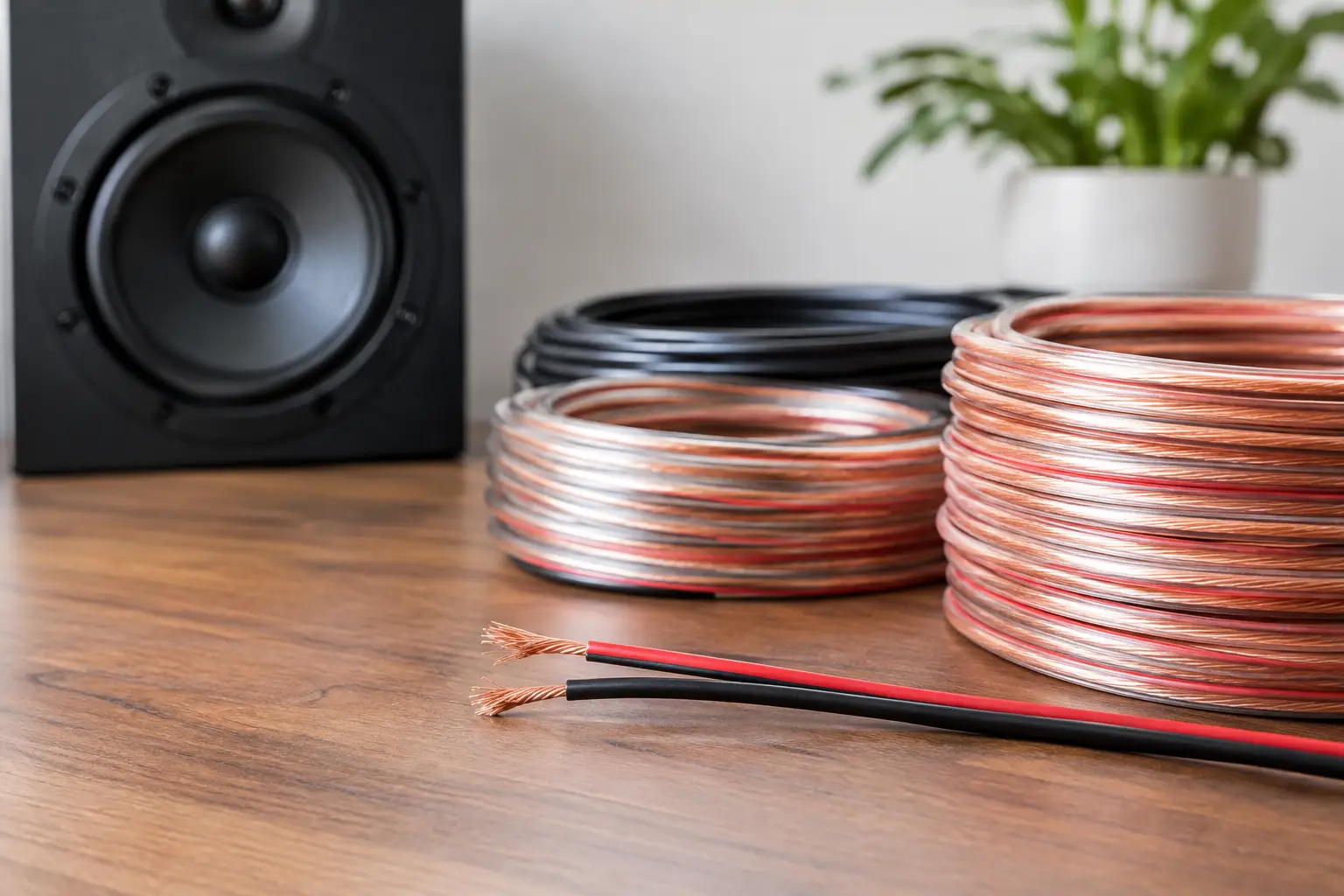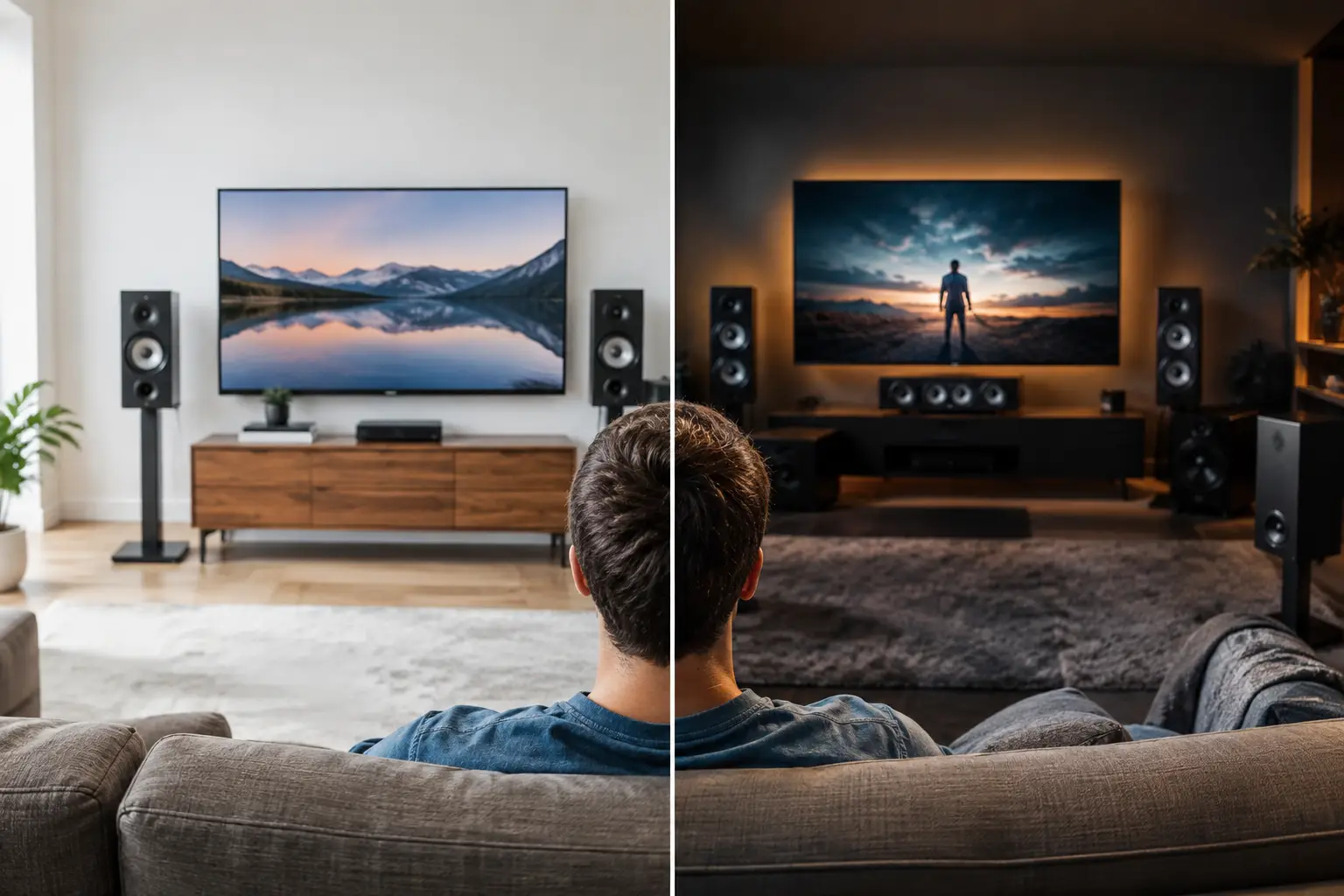
A beautifully resolved system can lose a measure of its authority through something as unglamorous as excessive cable resistance. When you select speaker cable gauge, the decision is not about chasing an exotic accessory. It is about preserving the amplifier’s grip on the loudspeaker so bass remains composed, dynamics arrive without hesitation, and the delicate space around a voice or violin is allowed to emerge intact.
For a serious music system, cable gauge deserves practical attention. The right choice is usually straightforward once you know the length of each run, your loudspeaker’s impedance behavior, and the demands you place on the system. The goal is simple: make the speaker cable electrically unobtrusive enough that the music, the amplifier, and the loudspeaker can do their work without needless compromise.
What Speaker Cable Gauge Actually Means
Speaker cable gauge is most often expressed in American Wire Gauge, or AWG. The numbering runs in the opposite direction from what many people expect: a lower number indicates a thicker conductor. A 12 AWG cable is thicker than 14 AWG, and 14 AWG is thicker than 16 AWG.
Thickness matters because every length of wire has resistance. As a cable becomes longer or thinner, resistance increases. That resistance sits between the amplifier and loudspeaker, slightly reducing the amplifier’s control over the speaker’s drivers. The result can be subtle, but in a revealing system subtle changes are often precisely what separate merely pleasing sound from convincing musical presence.
Cable is not an amplifier upgrade, nor should it be asked to become one. A well-chosen gauge simply avoids becoming the limiting factor. It lets a fine amplifier deliver current with confidence and allows a capable loudspeaker to preserve its intended tonal balance, bass definition, and dynamic contrast.
How to Select Speaker Cable Gauge by Run Length
Run length is the first consideration because the electrical path includes both conductors: one traveling from amplifier to speaker and one returning. A speaker positioned 25 feet from the amplifier effectively creates a 50-foot circuit. For installations where the two speakers are different distances from the amplifier, size each cable according to its own run rather than automatically treating both channels alike.
For many domestic listening rooms, 16 AWG is entirely suitable for short runs to conventional 8-ohm loudspeakers. Once runs approach 25 feet, 14 AWG becomes a more assured choice. At 50 feet and beyond, 12 AWG is often the sensible standard, particularly in systems designed for realistic scale and unrestricted dynamics.
The following ranges are useful starting points, not inflexible rules:
| Typical one-way cable run | Sensible starting gauge | | — | — | | Up to 25 feet | 16 AWG for most 8-ohm speakers; 14 AWG for added margin | | 25 to 50 feet | 14 AWG | | 50 to 100 feet | 12 AWG | | Over 100 feet | 10 AWG or a professionally planned installation |
Choosing one step thicker than the minimum is often wise when the cable will be concealed in walls, routed beneath floors, or otherwise difficult to replace. The price difference may be modest compared with the permanence of the installation, while the added margin protects performance as the system evolves.
Speaker Impedance Changes the Calculation
The nominal impedance printed on a loudspeaker is useful, but it does not tell the complete story. Loudspeaker impedance changes with frequency, and some sophisticated designs present lower impedance regions that ask more of an amplifier. A speaker rated at 4 ohms generally draws more current than an 8-ohm design at the same listening level, making cable resistance more consequential.
This does not mean every 4-ohm loudspeaker requires an extremely thick cable. It means the case for 14 AWG or 12 AWG becomes stronger, especially with longer runs. If your loudspeakers have a demanding impedance profile, substantial bass capability, or are regularly enjoyed at lifelike levels, choose conservatively.
The amplifier also matters. Powerful, stable amplifiers can sound exceptionally composed into challenging loads, but no amplifier benefits from adding unnecessary resistance between its output stage and the loudspeaker. Conversely, a modestly powered amplifier may gain audible ease from an appropriately sized cable because it is not surrendering part of its available voltage across a long, thin conductor.
Why Gauge Can Affect Musical Performance
In practical listening terms, undersized cable is most likely to reveal itself through bass and dynamics. Low frequencies can feel less taut and less clearly pitched. A kick drum may have impact but less definition around its leading edge; an acoustic bass may retain notes yet lose some of its woody articulation and rhythmic intent.
The effect is rarely as simple as “more treble” or “more bass.” Cable resistance interacts with the loudspeaker’s crossover and driver behavior, so results depend on the design. What discerning listeners often recognize is a slight reduction in ease: crescendos seem more constrained, images less firmly anchored, and musical lines less naturally connected.
With adequately sized cable, the improvement is not a hi-fi spectacle. It is a restoration of proportion. The orchestra has more assured foundation, the piano’s left hand carries proper weight, and a quiet vocal phrase can remain intimate even as the arrangement expands behind it. This is the quality of control that allows a loudspeaker to disappear and a performance to occupy the room.
Copper Quality, Construction, and Termination
Once you have chosen the correct gauge, conductor quality and construction deserve attention. High-purity copper is a natural choice for most premium systems because it offers excellent conductivity, durability, and a balanced sonic character. Oxygen-free copper is widely available and entirely appropriate when it is honestly specified and well manufactured.
Stranding affects flexibility and ease of installation more than it changes the basic gauge requirement. Fine-stranded cable bends gracefully around furniture and through conduits, while heavier constructions may be better suited to dedicated rooms and fixed installations. What matters most is that the cable is properly terminated and securely connected.
Bare wire can perform very well when freshly stripped, tightly secured, and periodically inspected. Spade connectors and banana plugs offer convenience, consistency, and a more refined finish, particularly where equipment is moved or connections are not easily accessible. Select connectors that fit both the amplifier and loudspeaker terminals securely. A loose connection can undermine the benefit of even the finest cable.
Avoid judging cable by thickness of insulation alone. A cable can look substantial yet use relatively small conductors. Look for the actual AWG rating, verify that it is stated per conductor, and favor transparent specifications over decorative claims.
Do You Need the Thickest Cable Available?
Not necessarily. There is a point at which extra thickness brings little practical benefit and introduces inconvenience. Very heavy cable can be difficult to route elegantly, may strain small binding posts, and can be unnecessarily expensive for a short run to an easy 8-ohm load.
There is also a difference between prudent headroom and system anxiety. A 12 AWG cable is an excellent, broadly capable choice for many high-performance installations, but a short 10-foot run does not automatically become more musical because it has been replaced with a much thicker conductor. Sound quality is shaped by the entire chain: room acoustics, loudspeaker placement, amplification, source quality, and the recording itself.
Bi-wiring is another area where restraint is useful. Some loudspeakers provide separate terminals for high and low frequencies, but bi-wiring is not universally beneficial. It requires two cable runs per speaker and should be evaluated in the context of the loudspeaker’s design, the amplifier, and the listener’s priorities. A single, properly sized cable with excellent connections is often the more elegant solution.
A Refined Approach for the Listening Room
Begin by measuring the real path your cable must follow, including turns around cabinetry or along baseboards. Do not estimate only the straight-line distance. Then consider the lowest nominal impedance of your loudspeakers and whether you listen at restrained levels or enjoy the full scale of a concert hall, jazz ensemble, or amplified performance.
For a typical premium two-channel system with runs under 25 feet, 14 AWG copper cable is a confident, versatile choice. Move to 12 AWG when runs are longer, loudspeakers present a 4-ohm load, or the system is intended to reproduce wide dynamic swings without constraint. These choices are technically sound and respectful of the investment represented by fine electronics and handcrafted loudspeakers.
Gershman Acoustics loudspeakers are created to communicate the physical presence, tonal color, and emotional architecture of a performance. Giving them an appropriately sized cable is a modest but meaningful part of honoring that intention. Once the connection is secure and the gauge is right, stop looking at the cable and return to what matters: the breath before a singer begins, the decay of a cymbal, and the quiet conviction of music reproduced with grace.