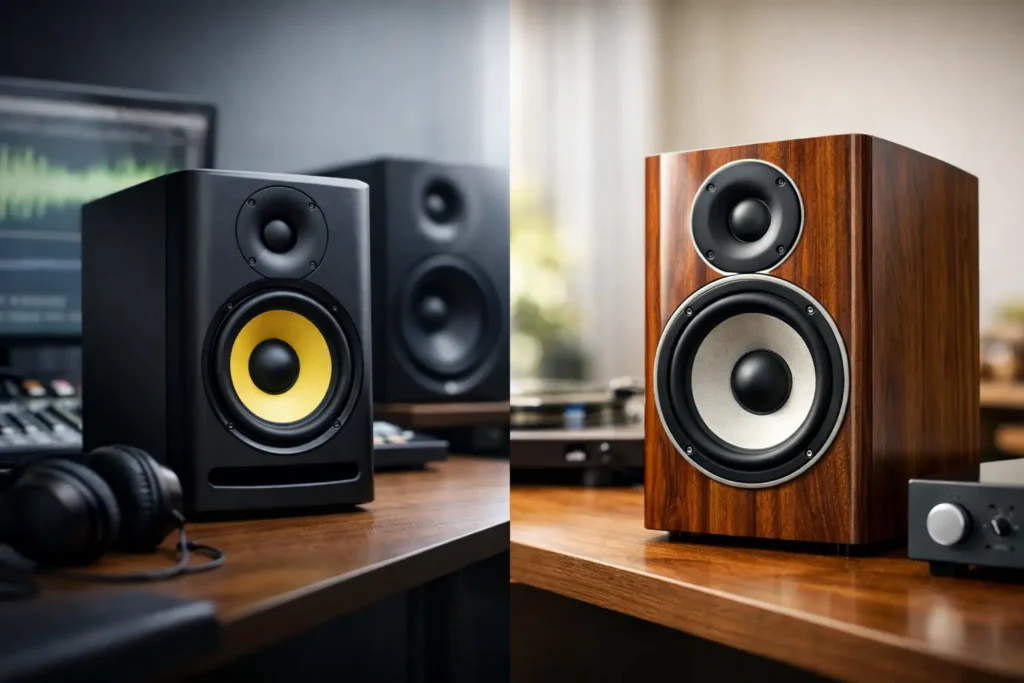
A pair of speakers can reveal every decision made at the mixing console, yet leave a favorite recording emotionally untouched. Another pair can make a familiar vocal feel present in the room, with a convincing stage and a sense of scale, while being less useful for identifying a narrow EQ issue. That distinction sits at the heart of studio monitors vs audiophile speakers. The question is not which category is inherently superior. It is which one serves the way you listen.
For the serious music lover, loudspeakers are not simply tools for producing sound. They are the final instrument in a system, translating the work of musicians, engineers, and producers into an experience that can be intimate, expansive, and deeply personal. Understanding the different design priorities behind monitors and high-end home speakers makes the choice far more meaningful.
Studio Monitors vs Audiophile Speakers: Different Missions
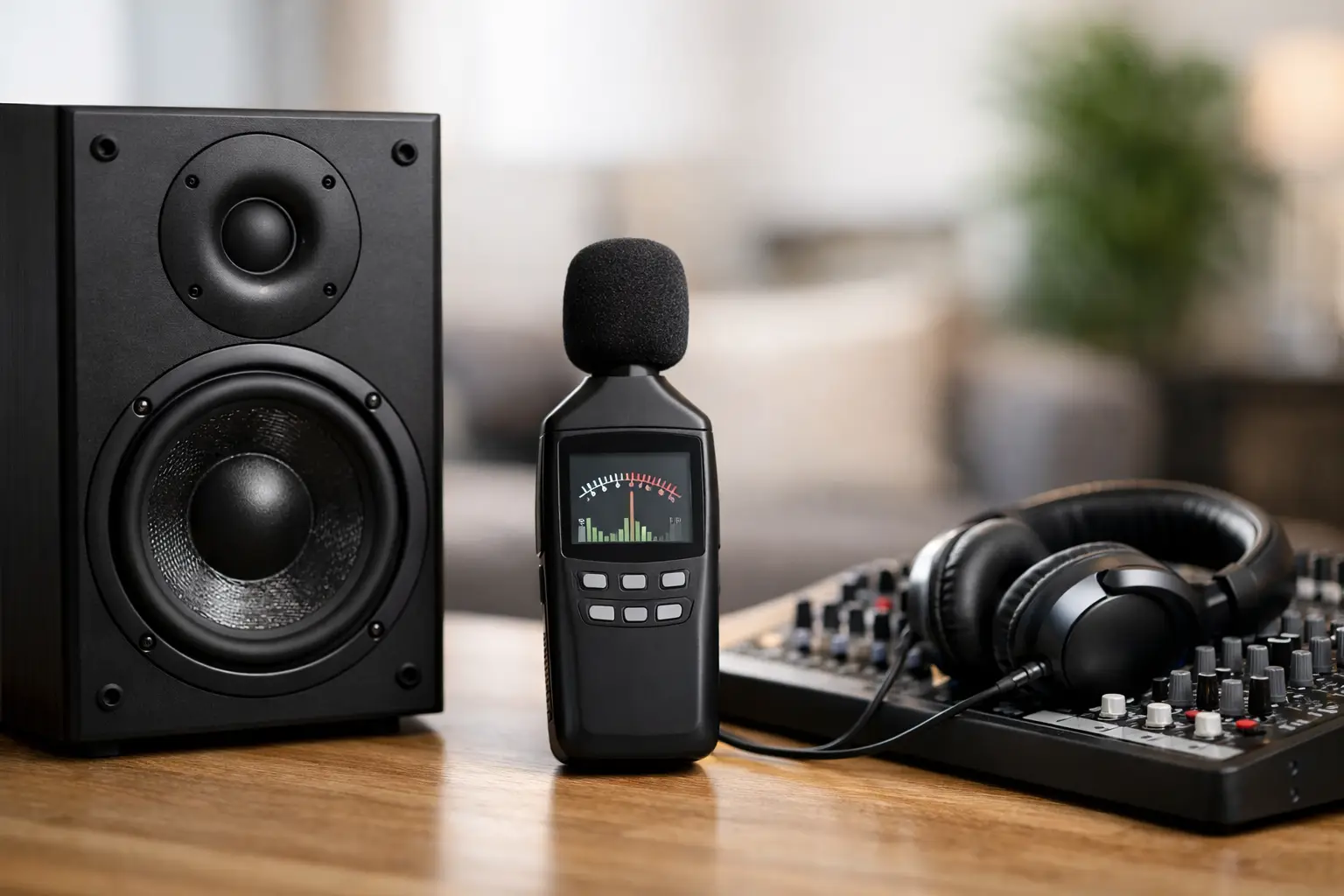
Studio monitors are designed primarily as reference tools. Their task is to help recording and mastering professionals make informed decisions. A monitor should expose flaws in a recording, clarify balance between instruments, and provide a dependable point of comparison from session to session. In practical terms, that often means controlled dispersion, close-range accuracy, and an honest presentation that does not flatter poor recordings.
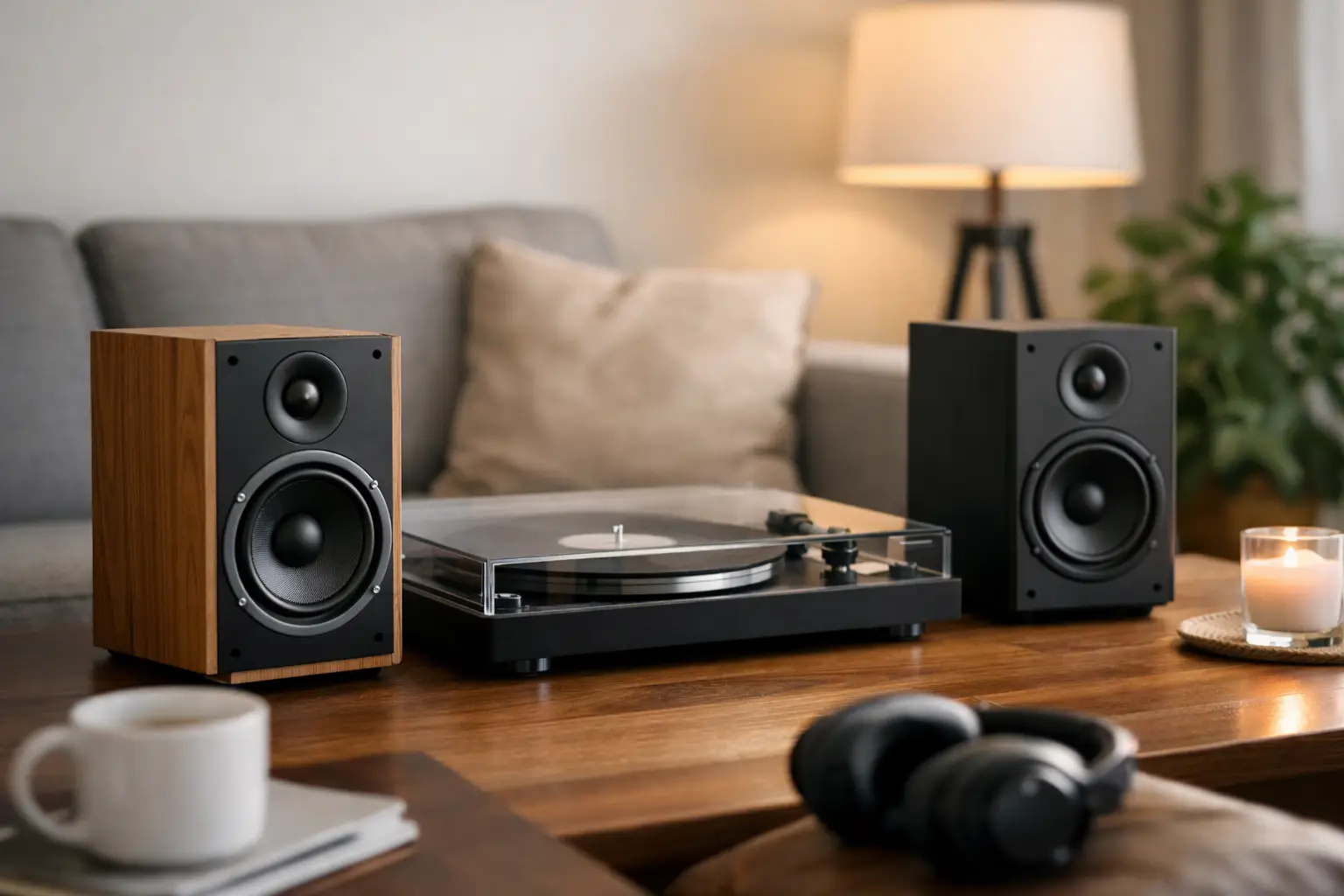
Audiophile speakers are designed for the finished musical experience in a home. Accuracy still matters greatly, but it is not pursued in isolation. A fine home loudspeaker must work with a larger listening room, a carefully chosen system, and the listener’s emotional expectations. It must convey tonal color, dynamics, space, timing, and the natural weight of instruments in a way that encourages long, absorbing listening.
Those purposes overlap, but they are not identical. A studio monitor may tell an engineer that a vocal is slightly too forward. An audiophile loudspeaker may tell a listener whether that vocal carries breath, vulnerability, and believable presence within the performance.
What “Neutral” Really Means
The word neutral is frequently used as if it settles the discussion. It does not. Neutrality is shaped by measurement methods, playback level, room acoustics, listening distance, and the intended application.
Many studio monitors are voiced for nearfield listening, typically from a short distance at a desk or console. This arrangement reduces the influence of the room and places emphasis on direct sound. It can be exceptionally useful when evaluating a mix, particularly in treated rooms. Active amplification, onboard equalization, and room-correction options are also common, making monitors practical and consistent in production environments.
A luxury floorstanding loudspeaker is generally expected to perform at a greater distance and in a more spacious domestic setting. Its interaction with the room becomes part of the design equation. The goal is not merely a smooth frequency response on paper, but a coherent musical presentation in which the speaker disappears and the recorded acoustic opens before the listener.
This is why two speakers that both claim neutrality can feel so different. One may be deliberately analytical, with sharply outlined transients and unvarnished detail. The other may preserve that detail while offering more dimensionality, tonal continuity, and ease over an entire evening of listening. Neither approach is automatically correct. Context is everything.
Nearfield Precision and Room-Filling Scale
Distance changes the experience. In a nearfield setup, the listener hears a large proportion of direct sound from the drivers. Stereo imaging can be exceptionally precise, and small changes in a recording are easy to identify. For a producer working on a vocal or an editor cleaning dialogue, this is an advantage.
At home, many listeners want the soundstage to extend beyond the physical boundaries of the cabinets. They want an orchestra to occupy a convincing width and depth, a jazz trio to have air around each player, and a bass line to possess both pitch definition and physical authority. Achieving that illusion asks more of a loudspeaker than close-range precision alone.
Cabinet design, driver integration, crossover execution, and bass alignment all matter. So does the ability to maintain composure as music grows in scale. A speaker can sound impressive with a sparse acoustic track yet become congested when a full orchestra, large-scale electronic production, or dynamic rock recording demands freedom and control.
High-end loudspeakers are often engineered around this broader experience. Their cabinets are not an afterthought or a decorative shell. The structure influences resonance behavior, bass definition, imaging stability, and the quiet background from which small musical details emerge. Fine materials and meticulous construction have an audible purpose as well as a visual one.
The Appeal and Limits of Studio Monitors
Studio monitors can be an excellent choice for certain home systems. A well-designed active monitor offers a compact, technically integrated solution. Because the amplifiers are matched to the drivers, it can deliver impressive control and value. For a smaller room, desktop system, secondary listening space, or listener who prizes close-up insight into recordings, monitors can be compelling.
They also suit people who enjoy hearing the architecture of a mix. If your pleasure comes from following compression choices, microphone placement, layering, and effects processing, their directness may be exactly what you seek.
The trade-off is that some monitors are optimized less for domestic elegance, large-room scale, or the relaxed reproduction of a broad music collection. Their cabinets may be visually utilitarian. Their voicing may be revealing to the point that bright, compressed, or imperfect recordings become tiring. Their low-frequency performance can also be limited by compact dimensions, even when a stated frequency specification appears ambitious.
This does not mean a monitor cannot be musical. Many are. It means the buyer should resist the assumption that professional equipment is automatically the highest expression of home listening. A recording studio and a private listening room ask for different forms of excellence.
Why Audiophile Speakers Are Voiced for the Long Listen
A thoughtfully engineered audiophile loudspeaker should not hide information. It should organize information into a convincing whole. The difference is profound. Detail without coherence can feel like inspection. Detail woven into natural timbre, stable imaging, and dynamic flow becomes music.
The finest designs balance seemingly competing demands. Bass should reach deeply without becoming slow or overbearing. Treble should reveal the shimmer of cymbals and the decay of a concert hall without turning brittle. Midrange should allow a voice, cello, or piano to sound embodied rather than outlined. Above all, transitions between drivers should feel continuous, so the listener hears an instrument rather than a collection of frequency bands.
This is also where craftsmanship matters. A beautifully finished loudspeaker earns its place in a discerning home, but its deeper value lies in the discipline beneath the finish: carefully selected drivers, rigid and thoughtfully damped enclosures, painstaking assembly, and voicing informed by long experience. At Gershman Acoustics, that philosophy is centered on musical realism rather than a checklist of specifications.
For a listener building a system around vinyl, high-resolution streaming, cherished recordings, and unhurried evenings with music, this balance can be transformative. The goal is not to make every album sound identical. It is to let each performance retain its character while remaining inviting enough to revisit.
Choosing for Your Room and Listening Habits
Before choosing either category, consider where and how you will listen. A compact, acoustically treated workspace is a natural environment for nearfield monitors. A dedicated listening room or well-appointed living space may favor speakers designed to energize a larger volume of air and create a more expansive soundstage.
Amplification is another dividing line. Most studio monitors are active, meaning amplification is built in. This can simplify setup, though it may limit the ability to tailor the system through a preferred amplifier. Audiophile speakers are often passive, allowing the owner to match amplification, source components, cables, and placement to personal taste. That flexibility demands more care, but it also makes the system a more enduring and expressive investment.
Do not overlook aesthetics. A loudspeaker that occupies a central place in a home should be worthy of being seen. Proportions, finish, and cabinet artistry are not superficial concerns when the system is part of the room in which life is lived. The ideal speaker complements the space visually while elevating it sonically.
Listen for Connection, Not Just Detail
When auditioning, use music you know intimately and listen beyond the first impressive moment. Notice whether voices remain natural at realistic levels. Listen to the decay of piano notes, the weight and texture of upright bass, and the space between instruments. Pay attention to whether you want to continue listening after the initial analysis is over.
Studio monitors may be the right answer when your priority is production accuracy, nearfield work, and a compact active system. Audiophile speakers may be the more rewarding choice when music is a central part of your home and you seek scale, beauty, and emotional truth from finished recordings.
The right loudspeaker is the one that makes you forget the equipment, return to the music you love, and hear something human in it that you had not quite heard before.