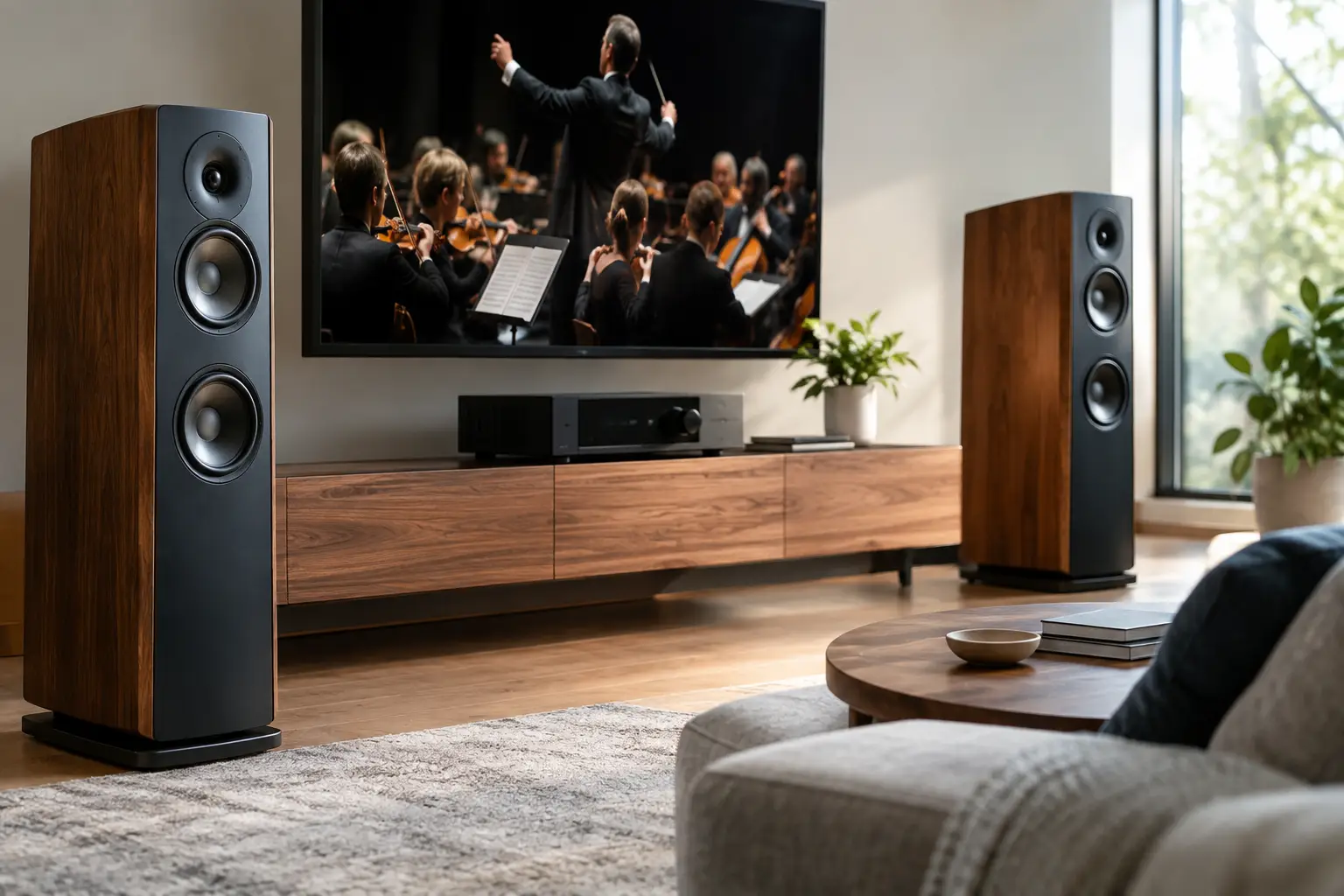
A fine loudspeaker can reveal the breath before a vocalist enters, the rosined texture of a bow, and the decay of a piano chord into silence. Yet those details do not exist in isolation. They meet the room, and the room answers back. Audio diffusion is one of the most elegant ways to shape that response: not by making a room lifeless, but by allowing music to expand with clarity, scale, and believable space.
For the discerning listener, room acoustics are not a secondary technical concern. They are part of the instrument. The loudspeaker, the furnishings, the architecture, and the listening position together determine whether a recording feels like a performance unfolding in the room or merely sound coming from two attractive cabinets.
What Audio Diffusion Actually Does
Audio diffusion scatters reflected sound in many directions rather than allowing it to return as a strong, concentrated reflection. A diffuser may use carefully calculated wells, curves, slats, or irregular surfaces to break up reflected energy across a range of frequencies. The goal is not simply to add visual texture to a wall. It is to make reflected sound less localized and less disruptive to what arrives directly from the loudspeakers.
This distinction matters because a domestic listening room contains many hard boundaries: walls, ceilings, windows, cabinetry, and floors. When sound strikes these surfaces, it reflects. Some reflections support a sense of spaciousness. Others arrive too soon or too forcefully, blurring image focus, exaggerating brightness, or flattening the depth encoded in a recording.
A properly chosen diffuser preserves acoustic energy while distributing it more gracefully. The result can be an enlarged soundstage that remains organized. A string section gains air around individual instruments. A singer occupies a more stable position between the speakers. Percussion carries impact without seeming to leap forward from the wall behind the system.
Diffusion is often confused with absorption, but they serve different purposes. Absorption reduces reflected energy, usually converting some of it to heat within porous material. It can be very useful for controlling excessive reverberation, bass buildup, and harsh early reflections. However, a room treated only with absorption can become overdamped, particularly in the midrange and treble. Music may sound tidy but smaller, less alive, and strangely detached from the room.
Diffusion, by contrast, retains much of that energy. It changes the reflection’s direction and temporal character. Neither approach is inherently superior. A room with bare glass and stone may need meaningful absorption before diffusion can do its finest work. A heavily carpeted, curtain-filled room may benefit more from diffusion to restore openness and sparkle. The art lies in hearing what the room is asking for.
Why Diffusion Matters to Musical Realism
The most convincing systems do not merely produce left, center, and right. They recreate a layered acoustic event. There is the direct sound from each loudspeaker, the recorded ambience of the venue, and the room’s own contribution. When those elements are in balance, the boundaries of the listening room become less noticeable. The performance seems to occupy a space larger and more dimensional than the physical system.
Audio diffusion can help preserve that illusion by reducing the acoustic signatures that call attention to nearby surfaces. A strong reflection from the rear wall, for example, can make an image feel glued to that wall. Diffusion can soften the wall’s presence without stripping away the sense of air that gives a symphonic recording its grandeur.
The benefit is not limited to classical music or audiophile recordings. A well-recorded jazz trio gains the intimacy of a club, with cymbals suspended naturally rather than rendered as a sheet of glare. On a close-miked vocal recording, diffusion can help the voice retain density and scale without becoming oversized or sibilant. Even dense electronic productions become easier to follow when layers are not competing with the same hard reflections.
This is why experienced listeners often describe an acoustically balanced room in emotional rather than technical language. They say the system disappears. They linger for another track. They recognize a familiar recording, then hear the hall, the studio, or the fragile silence around an instrument in a new way.
Where Diffusers Belong
Placement is determined by room geometry, loudspeaker position, listening distance, and the type of diffuser used. There is no universal wall treatment diagram that guarantees a result. Still, several locations deserve thoughtful consideration.
The wall behind the listener is often an excellent candidate, especially when the listening seat is close to it. A large reflective surface immediately behind the head can create distracting rear reflections and a sense of acoustic pressure. Diffusion in this area can open the room while maintaining an inviting, enveloping character.
The wall behind the loudspeakers can also be valuable, although the best approach depends greatly on how far the speakers sit from that wall. In some rooms, diffusion behind the system enhances perceived depth. In others, absorption or a combination of treatments better controls early reflections. Speaker design matters as well. A loudspeaker with generous low-frequency extension and a spacious radiation pattern will interact with the front wall differently than a compact monitor.
Side walls require particular restraint. The first reflection points can strongly affect imaging, but a diffuser needs adequate distance to develop its scattering behavior. In a narrow room, absorption at these points is often more practical. In a wider room with suitable listening distance, diffusion may preserve lateral spaciousness without compromising image precision.
Ceilings are frequently overlooked. A low, hard ceiling can contribute a pronounced reflection that reduces vertical openness and image focus. Architectural diffusion, integrated with care, can be both visually compelling and acoustically meaningful. It is especially attractive in dedicated listening rooms where every material is selected as part of a unified interior.
Scale, Frequency Range, and the Limits of Decorative Panels
Not every textured panel is a diffuser, and not every diffuser works effectively across the frequencies that matter most. The dimensions and geometry of a treatment determine the range over which it can scatter sound. A shallow decorative pattern may affect only the highest frequencies, while doing little for the midrange reflections that influence presence, image depth, and tonal naturalness.
This does not make smaller treatments useless. They can contribute to a room’s overall acoustic character, particularly when used in a thoughtful composition. But expecting a handful of lightweight panels to resolve deep room issues is unrealistic. Large-scale acoustic behavior generally requires appropriately scaled solutions.
The same caution applies to indiscriminate symmetry. Matching diffusers on every wall may look orderly, but the room may not need equal treatment everywhere. Listening rooms are not galleries of acoustic products. They are spaces for music, conversation, and living. The best installations respond to the room’s real behavior while respecting its architecture and the owner’s aesthetic standards.
For many luxury interiors, custom millwork, sculptural wall elements, bookcases with varied depths, and carefully selected furnishings can form part of a diffusion strategy. Their performance must be assessed honestly, not assumed from appearance alone. A wall of books, for instance, may provide useful irregularity, but its effect changes with book depth, density, and the spaces between volumes.
A More Intelligent Path Than Treating by Formula
The most satisfying rooms begin with placement. Before adding a single treatment, establish a sensible relationship between loudspeakers, boundaries, and the listening seat. Small changes in speaker distance from the front wall or side walls can alter bass weight, image depth, and tonal balance more profoundly than many accessories.
Then listen critically with recordings you know intimately. Use voices to judge image stability, acoustic instruments to assess timbre, and music with low-frequency information to identify boom or missing definition. Measurement can be highly informative, particularly for bass behavior and decay times, but it should support musical judgment rather than replace it.
A blended approach is usually the most refined. Bass control may be required in corners or along major boundaries. Selective absorption can calm damaging early reflections. Diffusion can preserve life, width, and dimensionality once the room is no longer shouting over the music. The proportions will differ in every space.
At Gershman Acoustics, the pursuit of lifelike reproduction begins with the loudspeaker but extends naturally to the environment in which it performs. A handcrafted loudspeaker deserves a room that allows its timing, tonal color, and spatial precision to emerge intact.
The most useful question is not, “Where can I add a diffuser?” It is, “What is the room preventing me from hearing?” Answer that with patience, and the reward may be a listening space that does not merely sound controlled, but feels beautifully, convincingly alive.