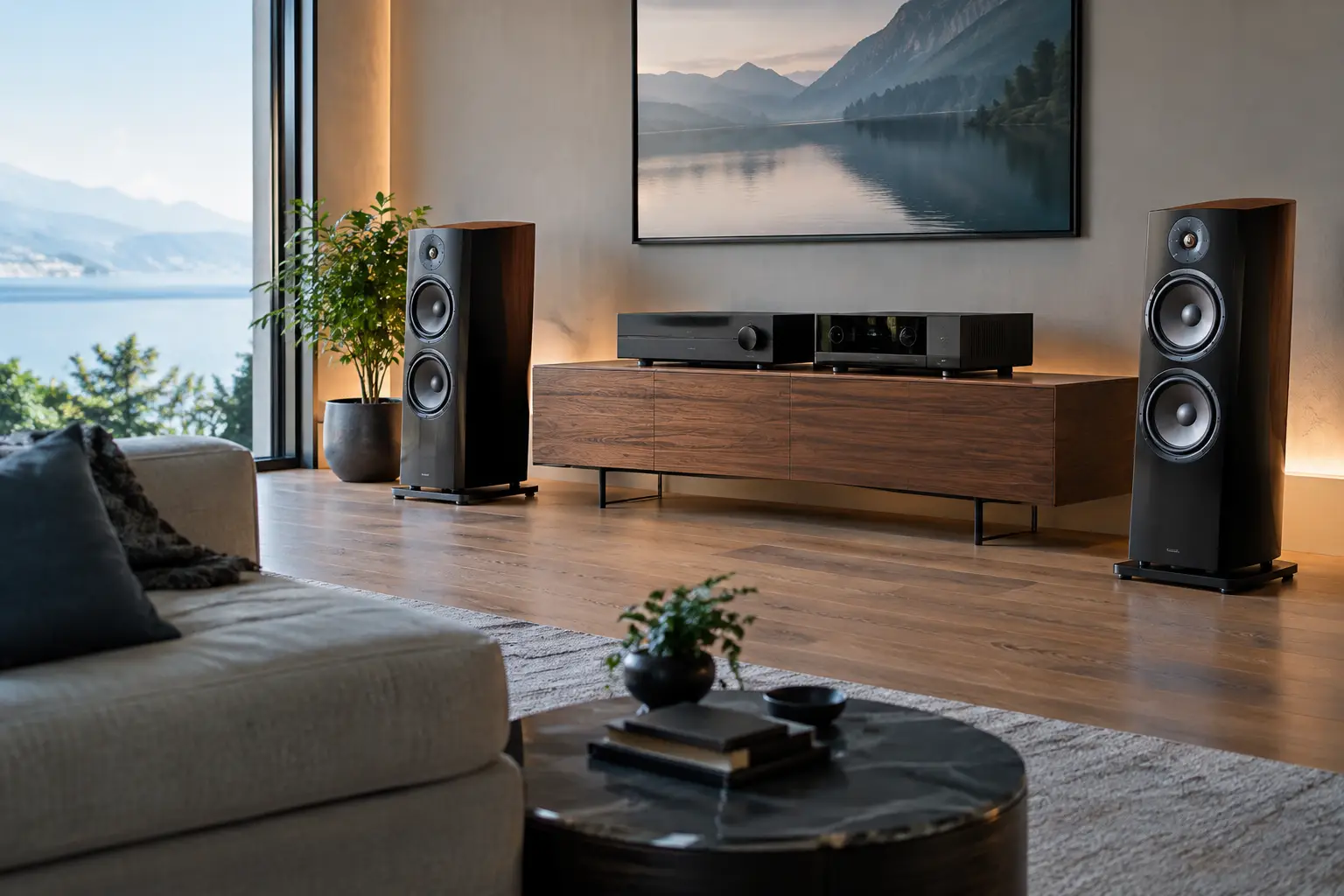
A loudspeaker can possess exquisite finish work, profound bass extension, and a beautifully resolved treble, yet still feel constrained if it is partnered with the wrong amplifier. This guide to speaker sensitivity clarifies one of the most quoted and misunderstood specifications in high-end audio: the figure that helps determine how effortlessly a speaker brings music to life in your room.
Sensitivity is not a scorecard for sound quality. A lower-sensitivity loudspeaker is not inherently less refined, nor is a high-sensitivity design automatically more musical. It is, however, central to the relationship between loudspeaker, amplifier, room, and listening habits. Understand that relationship, and system building becomes less about chasing numbers and more about preserving the scale, dynamic contrast, and emotional authority embedded in a recording.
What Speaker Sensitivity Actually Measures
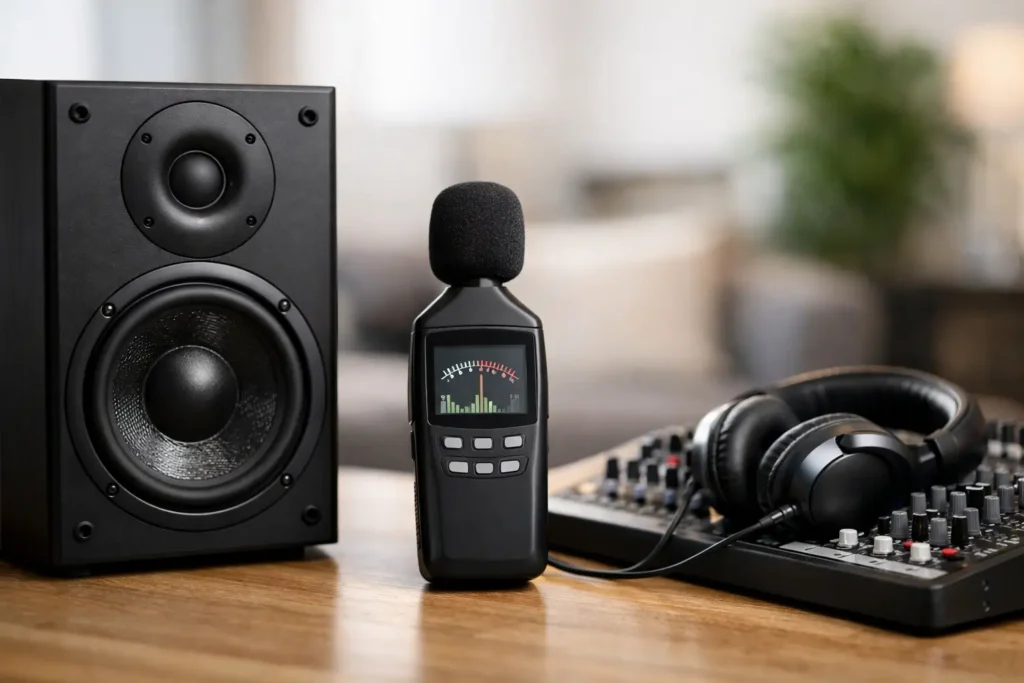
Speaker sensitivity indicates how loudly a loudspeaker plays for a given input, measured at a specified distance. It is commonly expressed in decibels as dB at 1 watt, measured at 1 meter. A rating of 88 dB, for example, means the speaker produces 88 dB of sound at one meter when supplied with one watt of power under the manufacturer’s stated test conditions.
The decibel scale is logarithmic, which makes modest-looking differences meaningful. A 3 dB increase in sensitivity requires roughly half as much amplifier power to reach the same listening level. A 10 dB increase is perceived approximately as a doubling of loudness and requires about ten times the power.
This is why sensitivity deserves attention before an amplifier is chosen. A 90 dB loudspeaker will generally play at a given volume with less power than an 84 dB loudspeaker. That difference can influence not only maximum loudness, but also the sense of ease during a large orchestral swell, a live drum transient, or the sudden dynamic shift of an intimate vocal recording.
The 2.83-Volt Qualification
Not every sensitivity figure is measured with one watt. Many specifications instead state output at 2.83 volts and one meter. With an 8-ohm speaker, 2.83 volts equals one watt, so the two descriptions align. With a 4-ohm speaker, however, 2.83 volts delivers two watts.
That does not make a 4-ohm loudspeaker misleading by definition. It simply means the sensitivity figure must be read alongside impedance. Luxury loudspeaker design often involves sophisticated crossover networks, carefully selected drivers, and cabinet loading choices made for tonal balance, bass control, and imaging rather than for the highest possible number on a specification sheet.
A Guide to Speaker Sensitivity in Real Rooms
Sensitivity ratings are typically taken in controlled conditions, while music is heard in living rooms, dedicated listening spaces, and architecturally distinctive interiors. The distance from the speaker matters considerably. As you move farther away, sound level decreases, often by about 6 dB each time the distance doubles in open space.
A speaker that appears easy to drive in a nearfield setting may demand more from an amplifier across a large, open-plan room. Conversely, a smaller listening space with some boundary reinforcement may allow a moderately sensitive speaker to produce satisfying levels with less power than expected.
The room also changes the character of the energy you hear. Hard surfaces can add brightness and reflections, while heavy furnishings and absorptive materials can soften the presentation. Neither condition is solved by choosing sensitivity alone. The goal is a system that retains clarity and dynamic expression without sounding strained, sharp, compressed, or overly forceful at the listening chair.
For many discerning listeners, realistic playback is not about extreme volume. It is about headroom. Music has peaks that rise far above its average level. An amplifier operating near its limit can flatten those peaks or clip, introducing harshness precisely when the music should open up. Adequate reserve power allows the system to reproduce sudden accents with greater composure and preserves the silence and delicacy around them.
Sensitivity and Amplifier Power
A useful starting point is to consider both average listening level and musical peaks. If a speaker has a sensitivity of 87 dB and your preferred listening position is several meters away, modest amplifier power may be enough for quiet jazz or chamber music. But demanding recordings, substantial rooms, and lifelike levels call for more reserve.
This does not mean every system needs an enormous power amplifier. Amplifier quality matters as much as its rated wattage. A well-engineered amplifier with a generous power supply, stable current delivery, and control over difficult loads can sound more authoritative than a higher-rated design that loses composure when the music becomes complex.
Impedance is especially relevant here. Sensitivity describes output for a given input, while impedance describes the electrical load presented to the amplifier. A loudspeaker can have respectable sensitivity yet still require a capable amplifier if its impedance drops low at certain frequencies or its phase behavior is demanding. The ideal partner is one that can deliver current cleanly and maintain tonal poise across the speaker’s full operating range.
Why More Power Can Sound More Relaxed
There is a common assumption that more amplifier power necessarily means louder playback. It can, but its more refined benefit is often effortlessness. With sufficient headroom, a piano has proper weight at the start of a note. A double bass retains pitch definition beneath a full ensemble. Brass can rise in intensity without becoming abrasive.
At ordinary levels, this reserve can make a system feel calmer rather than more aggressive. The amplifier is less likely to approach its limits, and the loudspeaker can express the recording’s natural contrasts with greater freedom.
High Sensitivity Is Not the Same as High Fidelity
A speaker rated at 95 dB may offer exceptional dynamic immediacy with relatively low-powered amplification. That can be a beautiful fit for certain systems and musical preferences. Yet sensitivity is achieved through design choices, and every choice involves trade-offs.
Driver area, crossover architecture, cabinet alignment, bass extension, impedance targets, and dispersion behavior all affect the final result. Pursuing maximum sensitivity may alter bass alignment or demand compromises elsewhere. Pursuing deep, controlled low-frequency performance from an elegant cabinet may yield a more moderate sensitivity rating while delivering a more complete musical foundation.
The better question is not, “What is the highest sensitivity available?” It is, “Does this loudspeaker reproduce music with conviction in the room and with the electronics I intend to use?” A truly accomplished design integrates sensitivity into a larger acoustic vision: tonal naturalness, coherent timing, stable imaging, low-level nuance, and the ability to remain composed as the music expands.
Choosing a Sensible Sensitivity Range
There is no universal ideal, but broad categories can provide context. Speakers in the mid-80 dB range often benefit from substantial, high-quality amplification, particularly in larger rooms or for listeners who enjoy concert-like dynamics. Around 88 to 91 dB is a versatile range for many premium stereo systems, offering compatible options across a wide field of capable amplifiers. Above roughly 92 dB, loudspeakers may achieve generous output with lower power, though their electrical behavior and overall design still deserve careful consideration.
These ranges are guides, not verdicts. An 86 dB loudspeaker paired with an excellent high-current amplifier can create a more compelling experience than a 93 dB design connected to electronics that cannot properly control it. Equally, a sensitive loudspeaker may be the inspired choice for a listener drawn to single-ended tubes, modest-power amplification, or the intimacy of a smaller room.
At Gershman Acoustics, musical realism is understood as a complete system of decisions, not a single specification. Cabinet integrity, driver integration, crossover execution, bass control, and refined voicing must work together so the listener hears a convincing performance rather than a collection of hi-fi effects.
How to Listen Beyond the Specification
When auditioning loudspeakers, begin at a natural level rather than immediately turning the volume up. Listen for the way a voice occupies space, for the decay of a cymbal, and for the distinct pitch and texture of low instruments. Then raise the level gradually. Does the presentation grow in scale while remaining composed? Do images remain stable? Does the music retain ease when a recording becomes dense?
Bring music you know intimately, ideally recordings with a wide range of dynamics. A solo vocal reveals tonal truth. Piano exposes timing and harmonic coherence. A well-recorded orchestra tests scale, layering, and headroom. Percussion can reveal whether the system delivers transient impact without hardness.
Ask about the amplifier used in the demonstration and its power rating into the speaker’s nominal impedance. Ask whether the room is similar in volume to yours. These practical details will tell you more than a sensitivity number viewed in isolation.
The most rewarding system is not the one that wins a specification contest. It is the one that lets a familiar recording reveal another shade of emotion, another breath, another moment of human intention – and invites you to stay for one more piece of music.