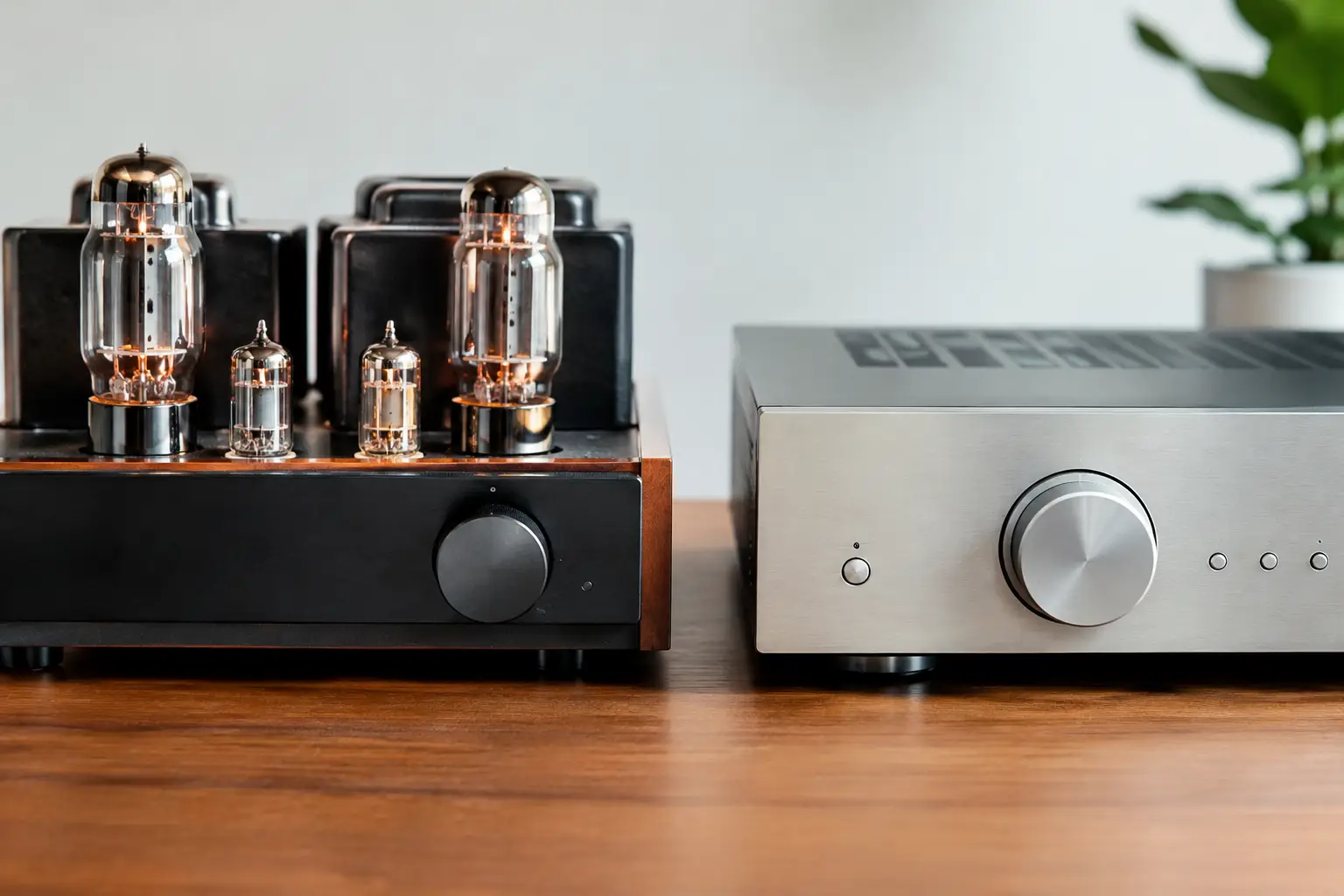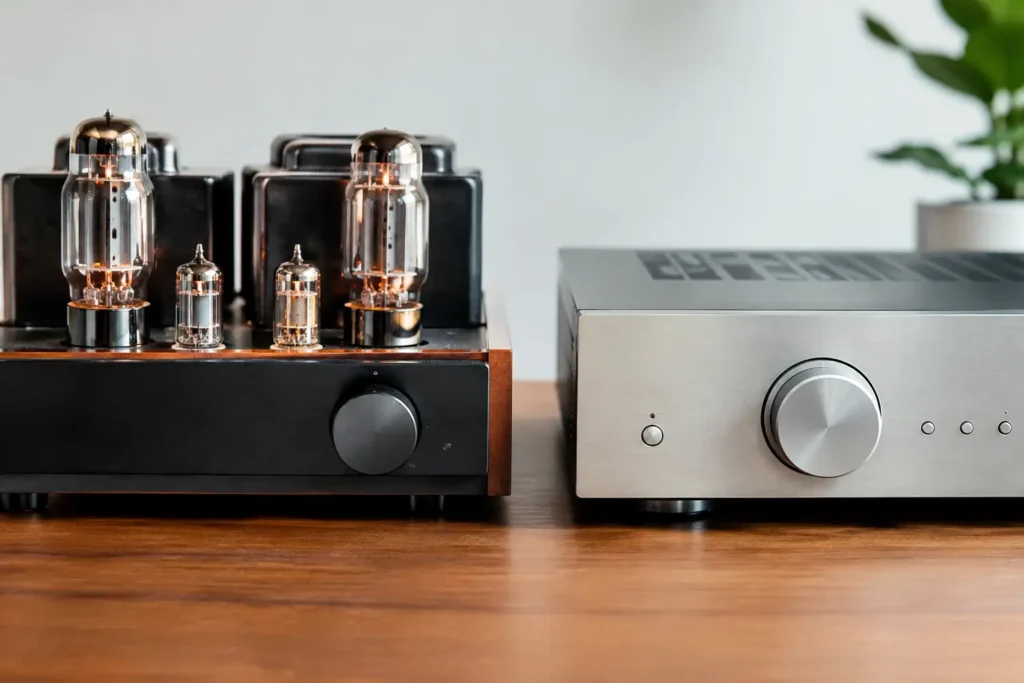
A solo cello can reveal the character of an amplifier within seconds. The bow’s first contact with the string, the bloom of the instrument’s wooden body, and the quiet decay into the hall all ask different things of a system. That is why the question of tube versus transistor amplifiers remains so compelling among serious music lovers. It is not simply a contest between vintage romance and modern engineering. It is a decision about how you want your recordings to breathe in your home.
For a beautifully resolved loudspeaker, amplification is not an accessory. It is the partner that determines how confidently the speaker controls a bass line, how naturally voices occupy the room, and how fully an orchestra expands beyond the cabinets. Neither approach is inherently superior. Each has strengths, limitations, and exceptional examples that can make a lasting musical impression.
Tube Versus Transistor Amplifiers: The Essential Difference
Tube amplifiers use vacuum tubes to amplify the delicate electrical signal from a source component. Transistor amplifiers, often called solid-state amplifiers, use semiconductor devices to perform the same fundamental task. The underlying purpose is identical, but their operating behavior, circuit design, and interaction with a loudspeaker can be strikingly different.
Many listeners associate tubes with tonal richness, dimensionality, and a tactile sense of presence. A fine tube amplifier can make a well-recorded vocal feel uncannily human, with subtle gradations of breath, phrasing, and harmonic color. Piano may carry more of its natural weight and glow. Strings can feel less reproduced and more physically present in the listening room.
Solid-state amplifiers are often valued for authority, grip, low noise, and dynamic ease. The best designs can start and stop a bass driver with remarkable precision, preserve the scale of large ensembles, and remain composed when music turns demanding. On a recording with deep synthesizer bass, full orchestral crescendos, or close-miked drums, that composure can be exhilarating.
These descriptions are useful starting points, not fixed laws. A superb transistor amplifier can sound richly textured and spacious. A well-designed tube amplifier can deliver surprising bass definition, speed, and extension. Implementation matters more than the label on the front panel.
Why Tube Amplifiers Feel So Immediate
The appeal of tubes is often discussed in terms of warmth, but warmth is too vague to explain what listeners actually hear. A more revealing description is harmonic structure. Tube circuits can add or preserve harmonic behavior in a way that many listeners experience as fluid, saturated, and forgiving without necessarily losing detail.
This quality can be especially persuasive with acoustic music, jazz ensembles, intimate vocals, chamber works, and recordings that capture real instruments in a natural space. Rather than putting every edge under a microscope, a great tube amplifier can allow the notes to connect. It may present the musical event as a continuous performance rather than a collection of hi-fi details.
There is also the matter of spatial realism. Tubes are frequently admired for their ability to create a generous soundstage with believable depth. When the recording supports it, a singer can seem to stand slightly forward of the loudspeakers while a piano extends behind them, surrounded by the acoustic signature of the studio or hall.
The trade-off is that tube amplifiers usually demand more consideration. Tubes age, generate heat, and eventually require replacement. Their sound can change as they warm up, and some owners enjoy the ability to tailor a system by selecting different tube types. Others would rather switch on the system and never think about bias settings or tube life.
Power is another practical consideration. While there are powerful tube amplifiers, many tube designs offer less output than similarly priced solid-state alternatives. That does not automatically make them unsuitable for full-range loudspeakers, but it makes matching more consequential. Speaker sensitivity, impedance behavior, room size, and preferred listening level should all be considered before choosing a low-powered design.
The Case for Transistor Control
A distinguished solid-state amplifier brings a different kind of confidence to a high-performance system. It can exert firm control over the loudspeaker’s woofers, producing bass that is not merely deep but shaped. The difference is apparent in the plucked string of an upright bass, the low pedal notes of an organ, or the sudden impact of a kick drum. The leading edge arrives cleanly, and the note stops when the recording says it should.
This control is particularly valuable with loudspeakers that present a challenging electrical load or with systems in larger rooms. A transistor amplifier’s current delivery and power reserves can preserve dynamic contrast at realistic levels. A symphonic climax should not compress into brightness or congestion. It should retain the layered force of brass, percussion, strings, and hall ambience.
Solid-state amplification also tends to offer practical ease. It is generally quieter, cooler-running, and lower-maintenance than tube equipment. For a listener who uses a system daily, appreciates extended listening sessions, and wants reliable command over a wide variety of music, these virtues are meaningful.
Older assumptions about solid-state sound deserve caution. There are transistor amplifiers that can seem dry, overly analytical, or mechanically etched, just as there are tube amplifiers that sound soft or overly colored. But those are not unavoidable traits of the technologies themselves. At the highest level, solid-state designs can combine tonal sophistication with exceptional transient precision and wide-bandwidth control.
Speaker Matching Matters More Than Allegiance
Choosing between amplifier types begins with the loudspeaker. A loudspeaker is not simply a passive recipient of power. Its impedance curve, sensitivity, crossover design, and driver behavior shape the demands placed on the amplifier. The most expensive amplifier is not necessarily the best choice if its electrical and musical character does not complement the speaker.
A tube amplifier can be extraordinary with a loudspeaker that has a stable impedance and sufficient sensitivity. The result may be open, expansive, and emotionally involving at modest to elevated volumes. Yet if the speaker’s impedance falls sharply in the bass or demands significant current, the same amplifier may lose definition and scale when the music becomes complex.
A powerful transistor amplifier may offer greater freedom with demanding loudspeakers, especially in a large listening room. It can maintain bass control and dynamic poise without working near its limits. Still, power ratings alone do not tell the whole story. The quality of the power supply, current capability, circuit topology, and voicing all influence the final result.
For this reason, auditioning is not a luxury. Listen to an amplifier with the loudspeakers you intend to own, in conditions that resemble your room and listening habits. Use music you know intimately. A favorite recording that has followed you for years will tell you far more than a short technical demonstration.
Your Room and Listening Habits Set the Priorities
Consider how you truly listen. If most evenings involve vocal jazz, small classical ensembles, folk, blues, or singer-songwriters at conversational levels, the dimensional grace of tubes may be deeply satisfying. If your collection moves from Mahler to electronic music, from stadium rock to cinematic scores, a high-current transistor amplifier may offer the scale and composure you want.
Room acoustics are equally influential. An overly lively room can make a forward system tiring, regardless of amplifier technology. A heavily furnished room may absorb some energy and benefit from a different balance of dynamics and openness. Amplification should be selected as part of a complete musical environment, not as an isolated component decision.
Aesthetic considerations also have their place in a luxury system. The glow of tubes can make an audio system feel like a ritual, an illuminated centerpiece that invites unhurried listening. A sculptural solid-state chassis can express another form of refinement: precision, permanence, and quiet authority. Both can belong naturally in a thoughtfully designed interior.
The Most Rewarding Choice Is the One That Keeps You Listening
It is tempting to frame tube versus transistor amplifiers as a final verdict. The better question is more personal: which amplifier lets you forget the equipment and return to the music? Some listeners find that magic in the dimensional color and gentle immediacy of tubes. Others find it in the unwavering control, silence, and dynamic freedom of solid-state.
At Gershman Acoustics, the goal is never to chase a fashionable sonic signature. It is to create a convincing musical experience in which instruments have body, voices have presence, and the emotional arc of a performance remains intact. The right amplifier is the one that honors that intention in your room, with your music, at the moments when you most want to listen.
Take the time to hear both approaches without preconception. When the system is truly well matched, the decision may become clear not through specifications, but through the unexpected urge to play one more record.