A great stereo system does not merely place sound between two loudspeakers. It creates the startling impression that a vocalist is standing in the room, a piano occupies real width and weight, and a violin section extends beyond the cabinets without losing its internal order. Knowing how to evaluate speaker imaging lets you recognize that difference with confidence – and separates a genuinely convincing musical presentation from an impressive but unfocused wall of sound.
Imaging is among the most revealing qualities of a high-end loudspeaker, yet it cannot be judged in isolation. It is shaped by the recording, the loudspeaker design, the room, speaker placement, and the listener’s position. The goal is not to chase exaggerated effects. It is to hear a stable, dimensional acoustic picture that serves the performance.
What Speaker Imaging Really Means
Speaker imaging is the system’s ability to place voices and instruments in precise, believable locations within the stereo soundstage. A strong center image might make a singer appear directly in front of you rather than vaguely spread between the speakers. Excellent imaging also reveals depth: a drummer can sit behind the vocalist, while a guitar may appear slightly forward and to one side.
Soundstage and imaging are closely related, but they are not identical. Soundstage describes the overall perceived space – its width, height, and depth. Imaging concerns the focus and placement of individual musical elements within that space. A system can sound very wide yet lack image specificity. Conversely, an intimate recording can produce exceptionally precise images without extending far beyond the speaker boundaries.
The finest result is not a collection of audio effects. It is coherence. The musical picture should feel naturally organized, with each performer occupying a stable position and the recording venue retaining its own acoustic character.
How to Evaluate Speaker Imaging: Set the Stage First
Before judging a loudspeaker, establish a listening arrangement that gives it a fair opportunity. Even an exquisitely engineered design will struggle to image properly if one speaker sits in a corner while the other opens into a large adjoining space, or if the listening chair is far off-center.
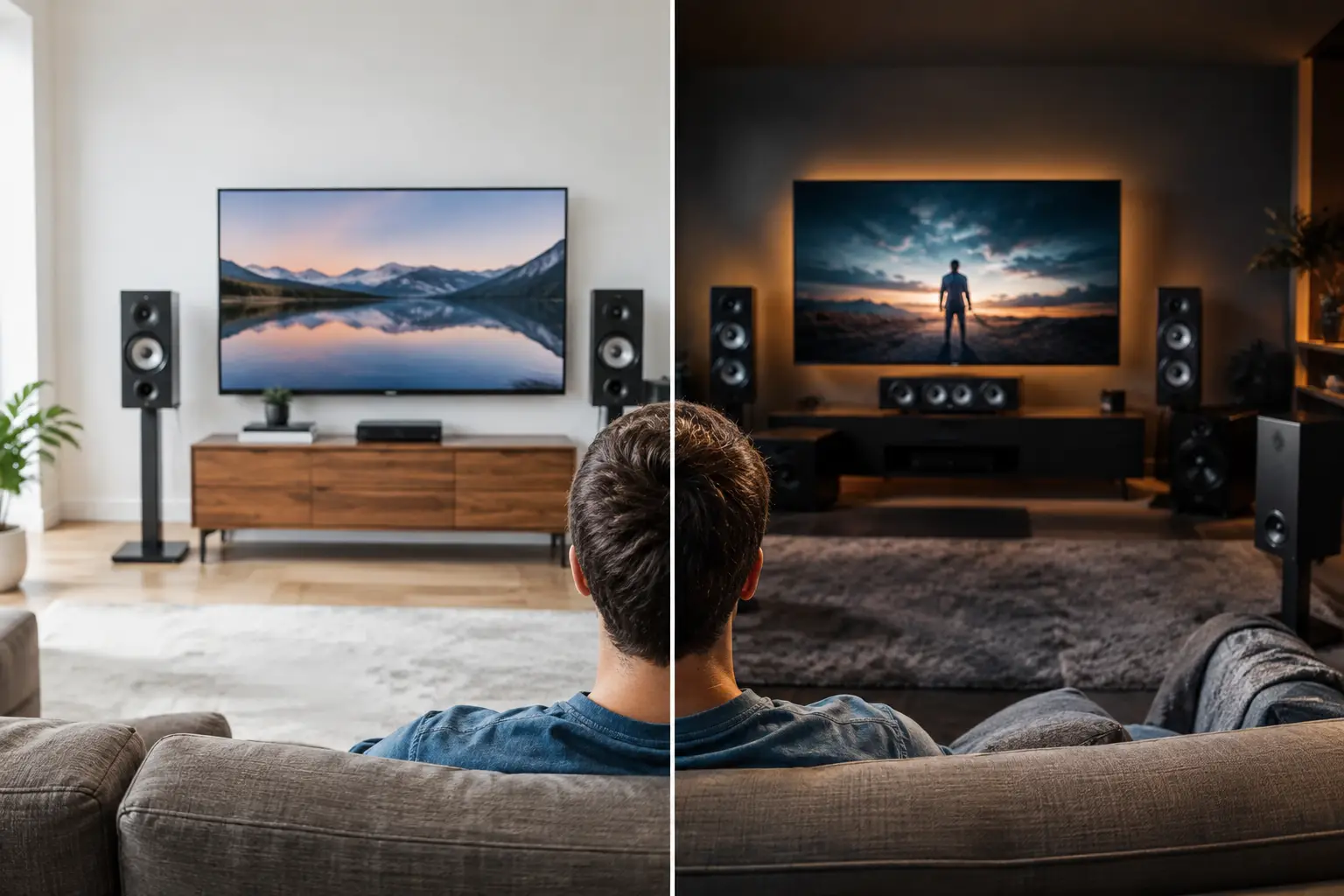
Begin with the speakers and listening seat forming an approximate equilateral triangle. If the speakers are eight feet apart, start with your listening position about eight feet from each speaker. This is a starting point, not a law. Larger speakers, larger rooms, and personal listening preferences may call for a different proportion.
Keep both loudspeakers equally distant from the listening position. Use a tape measure rather than trusting the eye. A difference of even a fraction of an inch can soften a center image, especially with recordings built around a closely miked vocal. Give the speakers room to breathe from the front wall and, where possible, avoid placing one speaker dramatically closer to a sidewall than the other.
Toe-in is equally consequential. With the speakers aimed more directly at the listener, center focus often becomes sharper and tonal balance may become more direct. Reducing toe-in can broaden the stage and create a more relaxed presentation. Neither choice is universally superior. The right setting is the one that holds the center image firmly while allowing the stage to open naturally beyond the loudspeaker positions.
Start With a Familiar Voice
A well-recorded solo vocal is the most useful first test. Choose music you know intimately, preferably a recording with minimal studio processing and a voice centered in the mix. Sit still at the primary listening position and ask a simple question: does the singer occupy a distinct, stable place in space?
On a well-set-up system, the voice should not sound as though it is coming from the left cabinet, the right cabinet, or an indistinct zone floating between them. It should appear centered, appropriately sized, and free of a fuzzy halo. When the singer rises in intensity, the image should remain anchored rather than drifting upward, widening unnaturally, or pulling to one side.
Then move your head a few inches left and right. Some change is normal. Stereo imaging is most convincing at the intended listening position. But a high-quality system should not make the vocalist collapse into the nearest speaker with the smallest movement. A reasonably stable center image suggests that placement, channel balance, and loudspeaker behavior are working together well.
Listen for Width, Depth, and Separation
Once the center is established, use recordings with a small jazz ensemble, chamber group, or naturally recorded acoustic performance. These reveal whether a system can portray more than a strong central vocal.
First, assess width. Do instruments spread across a believable lateral space? On some recordings, a cymbal, guitar, or backing voice may appear outside the physical boundaries of the speakers. This can be persuasive, but width alone is not proof of excellence. If the entire presentation seems stretched thin across the room, the system may be prioritizing spectacle over image density.
Next, listen for depth. In a convincing recording, performers should not all occupy the same flat plane. You may sense a vocalist slightly forward, percussion farther back, and ambient information extending behind the main performers. Depth is often more difficult to achieve in a domestic room because reflections from the wall behind the speakers can either enrich the impression of space or blur it. The key is whether the layers remain intelligible.
Finally, attend to separation. This does not mean each instrument should sound isolated, dissected, or artificially outlined. Music is an ensemble art. Instead, notice whether you can follow the line of a double bass beneath a piano, or locate a saxophone without losing the body and harmonic bloom of the surrounding performance. Precision should heighten musical involvement, not turn a recording into a technical demonstration.
Use the Room as a Diagnostic Tool
If the image leans consistently to one side, begin with practical causes. Confirm that the amplifier channels are balanced, that connections are secure and correctly polarized, and that both speakers are at matching distances from the chair. Then examine the room. A large glass surface, open doorway, heavy shelving, or nearby corner on one side can alter reflections enough to pull the apparent center away from the middle.
A center image that is broad but vague often responds to careful adjustments in toe-in and speaker spacing. Move one variable at a time, in small increments. A half-inch or one-degree adjustment can be audible in a resolving system. Listen after each change for more than a few seconds. The ear quickly adapts, so return to the same musical passage and compare patiently.
Do not assume that heavy acoustic treatment is the automatic answer. An overly damped room can make images seem dry and spatially constricted, while an untreated reflective room can produce glare and positional confusion. The most satisfying rooms retain a sense of life while controlling the earliest, strongest reflections that compete with the direct sound.
Choose Recordings That Tell the Truth
Not every beloved album is useful for evaluating imaging. Dense pop productions, heavily compressed masters, and recordings with artificial stereo effects can still be enjoyable, but they may not reveal what the loudspeakers are truly doing.
Keep a small reference selection that includes a centered vocal, an acoustic ensemble, a large orchestral work, and a live recording with audible venue ambience. The vocal tests center focus. The small ensemble exposes instrumental placement. The orchestra tests scale, layering, and the ability to preserve order when many musicians play at once. A well-recorded live performance reveals whether applause, room decay, and audience cues create a believable environment rather than a wash of indistinct reverberation.
It also helps to use recordings with different production styles. A speaker that images beautifully only on one pristine audiophile release may be flattering the material rather than communicating its full capability. A more mature design will maintain composure across intimate vocals, complex orchestral passages, and energetic contemporary recordings, while allowing each production to retain its own character.
Avoid the Most Common Misreadings
Imaging is easy to overvalue when evaluating equipment at a show or during a brief audition. A sharply etched center image can be captivating, but it may come with a narrowed sweet spot, lean tonal balance, or reduced sense of dynamic ease. Similarly, sound that seems to leap far outside the speakers may be thrilling on one track and less convincing on music that demands scale and tonal weight.
A convincing image also depends on tonal accuracy. If a loudspeaker makes the upper midrange too prominent, voices may appear unusually close and sharply outlined, yet lose their natural body. If bass is uncontrolled, it can obscure the spatial foundation of a recording and make the stage feel less stable. Imaging is therefore not a party trick added after the fact. It is the audible result of controlled dispersion, cabinet integrity, driver integration, phase behavior, and thoughtful room interaction.
This is why handcrafted loudspeakers from Gershman Acoustics are voiced with the musical whole in mind: image focus, tonal balance, dynamic expression, and the physical presence of instruments must support one another.
Give the Performance Time to Appear
The most meaningful imaging test is not a quick sweep through familiar effects. Spend an evening with a complete album. Notice whether you stop tracking the positions of instruments and begin responding to phrasing, tension, atmosphere, and emotion. That is the deeper measure of success.
When a system is properly placed and genuinely capable, the loudspeakers become less visually relevant. The room gives way to the recorded performance, and music gains the dimensional presence that invites you to listen longer.