A pair of loudspeakers with four binding posts can invite a seductive question: is there still more music to be revealed? In the conversation around biamping versus biwiring, the answer is sometimes yes, but never automatically. Additional cable runs and additional amplifiers can be purposeful tools. They can also add cost, complexity, and opportunities for imbalance without bringing a listener closer to the recording.
For a finely resolved system, the goal is not to accumulate hardware. It is to preserve the timing, tonal color, dynamic contrast, and spatial cues that allow a vocal performance, a string quartet, or a full orchestra to feel convincingly present in the room. The best choice depends on the loudspeaker’s crossover architecture, the amplifier’s character and capability, the room, and the musical experience you want to protect.
Biamping Versus Biwiring: The Essential Difference
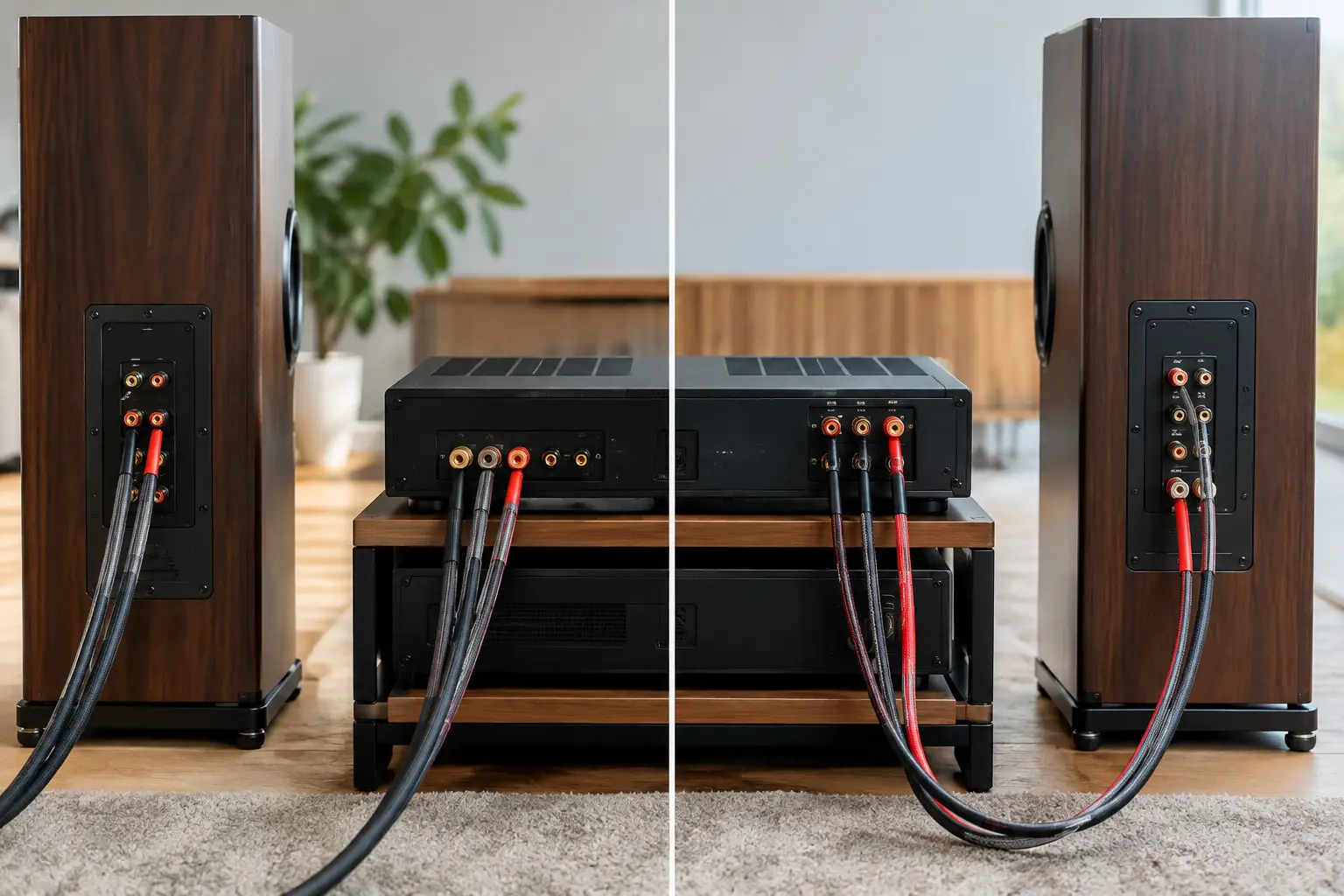
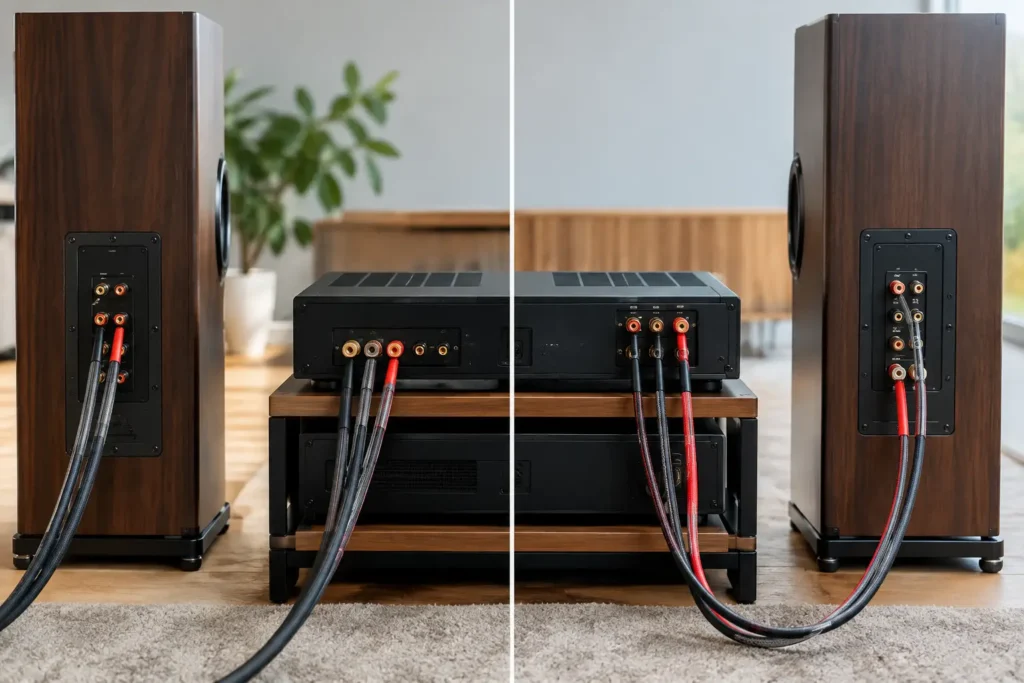
Bi-wiring uses one amplifier channel per loudspeaker, with two separate speaker-cable runs connected to the same amplifier output. One run feeds the low-frequency section of a compatible speaker; the other feeds the midrange and high-frequency section. The metal jumpers linking the speaker’s separate binding posts must be removed before the two cable runs are connected.
Biamping uses two amplifier channels per loudspeaker. One channel drives the low-frequency section and another drives the midrange/high-frequency section. This can be accomplished with two stereo amplifiers, a multichannel amplifier, or monoblocks arranged in a suitable configuration.
The distinction matters because bi-wiring does not add amplifier power or create electrical isolation between the speaker’s frequency sections at the amplifier. Biamping can. Yet even here, the details are decisive: passive biamping still relies on the loudspeaker’s internal passive crossover, while active biamping places an electronic crossover before the amplifiers and bypasses, or substantially redesigns, the speaker’s passive crossover network.
For most luxury home audio systems, the practical comparison is between bi-wiring and passive biamping. Active systems can be extraordinary, but they require engineering discipline rather than casual experimentation.
What Bi-wiring Can, and Cannot, Change
With a bi-wireable loudspeaker, separate cable runs may reduce the interaction between the current demands of the bass section and the delicate signal feeding the upper-frequency section. In a carefully matched system, listeners sometimes hear a modest improvement in openness, low-level detail, bass definition, or image focus.
That improvement is not a universal law. A well-designed loudspeaker crossover already works hard to manage the relationship between its drivers. A high-quality single-wire connection, properly terminated and of appropriate gauge for the run, can be exceptionally satisfying. In many systems, better loudspeaker placement, more precise toe-in, or improved room treatment will produce a greater and more repeatable gain than changing from single wiring to bi-wiring.
Bi-wiring is often worth considering when a speaker manufacturer provides separate terminals specifically for that purpose, the system is already well sorted, and the listener has access to identical cable runs. It is a comparatively low-risk experiment, provided the factory jumpers are removed and the amplifier is stable with the speaker load.
It is not a remedy for a thin tonal balance, uncontrolled bass, or an amplifier that lacks the current delivery needed to command a demanding loudspeaker. Cable cannot substitute for sound engineering elsewhere in the chain.
Why Passive Biamping May Offer More
Passive biamping assigns separate amplifier channels to different sections of the loudspeaker. Because the bass section no longer shares an amplifier channel with the upper-frequency section, demanding low-frequency passages may have less influence on the amplifier resources available to reproduce voices, cymbals, and the harmonic texture of acoustic instruments.
When successful, passive biamping can bring a sense of ease at realistic levels. Bass transients may sound more composed, large-scale recordings may retain better separation as arrangements become dense, and the system may feel less strained during crescendos. These are not merely technical effects. They can make a familiar performance feel more continuous and emotionally convincing.
Vertical and Horizontal Biamping
Vertical biamping uses one stereo amplifier for each loudspeaker. One channel of that amplifier drives the bass terminals and the other drives the upper-frequency terminals. This arrangement gives each speaker its own power supply and often preserves excellent left-right symmetry.
Horizontal biamping uses one stereo amplifier for both bass sections and another stereo amplifier for both upper-frequency sections. It can be appealing when using different amplifiers chosen for their respective strengths, such as a high-current design for bass and a particularly refined amplifier for the midrange and treble.
Neither approach is inherently superior. Vertical biamping with two identical amplifiers is usually the more straightforward route, particularly when consistency of gain, voicing, and channel behavior is important. Horizontal biamping can be rewarding, but it requires more careful matching.
The Matching Problem Few Conversations Emphasize
Two amplifiers can sound wonderful independently and still be unsuitable partners in a passive biamped system. The central issue is gain. If one amplifier produces more output voltage than the other for the same input signal, the loudspeaker’s tonal balance shifts. A small gain mismatch can make the presentation seem brighter, darker, leaner, or more forward than intended.
Ideally, the amplifiers should have identical gain specifications, similar polarity behavior, and compatible input sensitivity. Using identical models removes much of the uncertainty. If different amplifiers are used, a preamplifier or processor with precise level control may be necessary to achieve an appropriate balance.
There is also a practical safety consideration. Never leave the binding-post jumpers in place when biamping or bi-wiring. With biamping, the jumpers can connect the outputs of two amplifiers together, a mistake that may damage equipment. Confirm the loudspeaker manual, observe polarity with care, and power down the system before changing connections.
Active Biamping Is a Different Discipline
Active biamping can offer genuine technical advantages because each amplifier receives only the frequency range it must reproduce. The amplifiers work directly with the drivers through an active crossover, potentially improving headroom, control, and precision.
But the word “potentially” deserves respect. The passive crossover in a sophisticated loudspeaker is not a simple divider of bass and treble. It may shape driver response, manage phase, control resonances, and establish the tonal and spatial integration the designer intended. Replacing or bypassing it requires accurate crossover slopes, frequency points, level matching, time alignment, protection, and measurement. A poorly implemented active arrangement can sound impressive in isolated moments while losing the coherence that makes music believable over an entire evening.
For this reason, active biamping is best pursued in systems designed for it from the outset or under the guidance of an experienced designer, dealer, or technician. It is not simply passive biamping with one extra component.
How to Decide in a High-End System
Begin with the loudspeaker. Does it provide separate terminals? Does the manufacturer explicitly support bi-wiring, passive biamping, or both? The presence of four binding posts is an invitation to investigate, not a guarantee of transformation.
Then consider the amplifier. If it already has ample current reserve, stable behavior into difficult loads, and sufficient power for your listening room, bi-wiring may be the more elegant experiment. If your system becomes congested during complex orchestral passages or loses composure at lifelike volume, passive biamping with properly matched amplification may be more meaningful.
Finally, listen methodically. Use familiar recordings with natural voices, sustained piano notes, low-frequency punctuation, and dynamic swings. Keep levels as closely matched as possible. Do not judge the change by treble sparkle alone. The more meaningful question is whether the system preserves musical ease, scale, tonal truth, and the quiet spaces around performers.
At Gershman Acoustics, the pursuit of realism begins with the loudspeaker as a complete instrument, where cabinet, drivers, crossover, and voicing are conceived as one musical statement. Any change to amplification or cabling should honor that integration rather than distract from it.
The most rewarding system is rarely the one with the most elaborate wiring diagram. Choose the arrangement that lets a singer’s phrasing, a bowed cello’s resonance, and the sudden force of a bass drum arrive with greater conviction. When the equipment disappears and the performance remains, you have made the right decision.