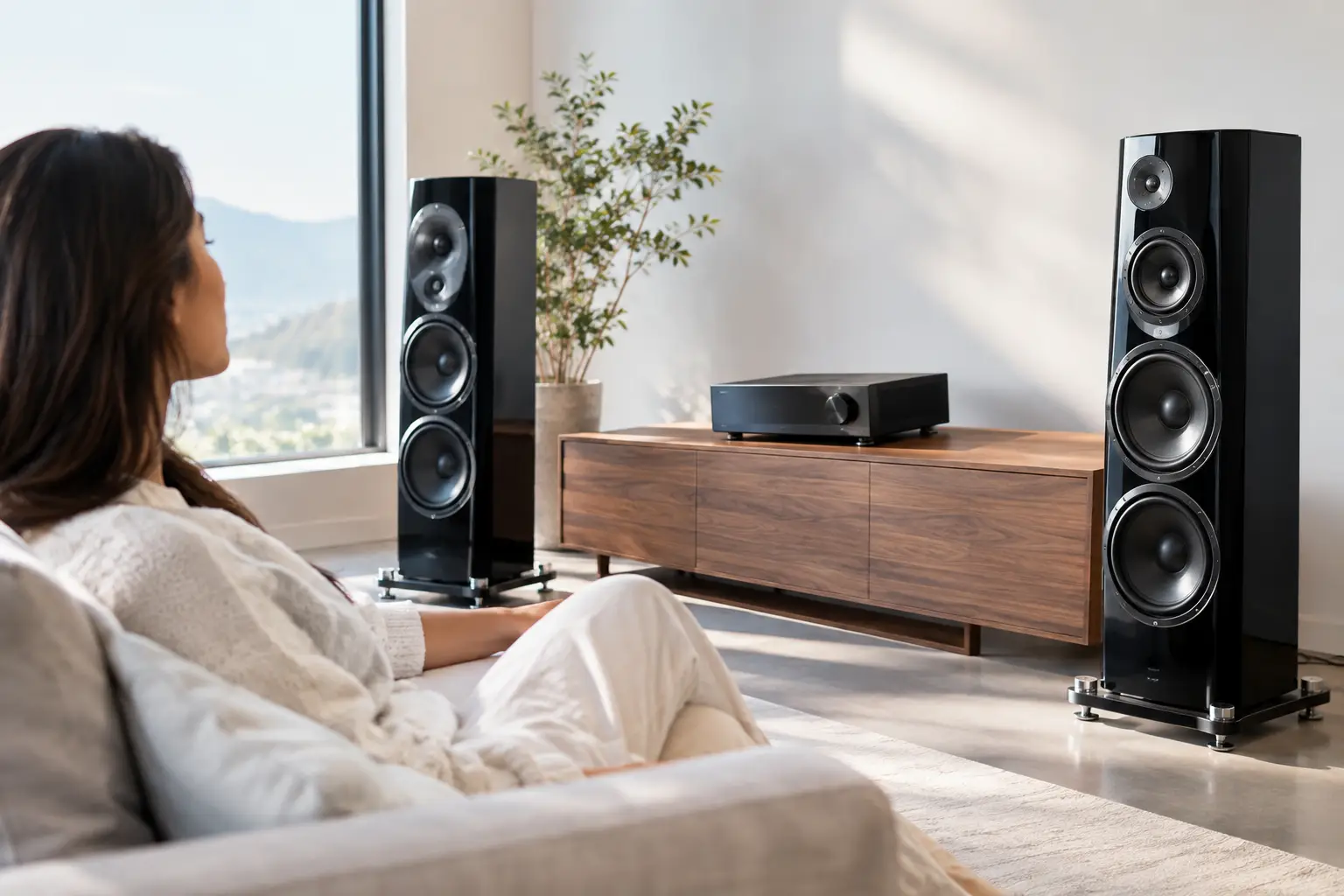
A great loudspeaker has always done more than produce sound. It has changed the scale of a room, suspended disbelief, and made a familiar recording feel newly alive. The future of high end speakers will not be defined by technology for its own sake. It will be shaped by a more demanding expectation: that a loudspeaker should honor the musical event, complement the home, and remain worthy of listening to for decades.
For discerning listeners, that is an encouraging future. Convenience will continue to improve, but the most meaningful advances will serve a timeless goal – bringing the texture of a voice, the force of an orchestra, and the human intention behind a performance closer to the listener.
The Future of High End Speakers Begins With Musical Truth
Audio has never lacked specifications. Frequency response, sensitivity, amplifier power, and digital resolution all matter. Yet none of them alone can explain why one system makes a listener stay for one more track while another, despite impressive numbers, leaves the music emotionally distant.
The finest loudspeakers of the future will continue to be judged by this harder standard. Can they preserve the natural weight of a cello? Can they reveal the fragile breath before a singer enters? Can they allow a complex arrangement to expand without turning dense, bright, or fatiguing?
This calls for engineering with restraint. Greater processing power and more sophisticated measurement tools can help designers identify cabinet resonances, refine crossover behavior, and control driver motion with extraordinary precision. But a loudspeaker is not a laboratory instrument alone. Its ultimate purpose is to communicate music in a way that feels unforced and complete.
That distinction matters because high-end listening is not a race toward hyper-detail. Excess detail can become a kind of glare, exposing the edges of a recording while diminishing its body and flow. The next generation of exceptional loudspeakers will combine resolution with tonal continuity, dynamic freedom, and the ease that makes long listening sessions deeply satisfying.
Intelligence Will Serve the Room, Not Replace the Speaker
Listening rooms are changing. Dedicated music rooms remain deeply valued, but many luxury systems now live in architecturally ambitious spaces with glass, stone, open plans, and carefully chosen furnishings. These rooms can be beautiful while posing genuine acoustic challenges.
Room correction, active bass management, and calibration tools will become more refined and discreet. Used well, they can address troublesome low-frequency behavior and help a system perform with greater consistency. They are especially useful where speaker placement must accommodate the realities of a home rather than an idealized listening triangle.
Still, digital correction has limits. It cannot turn an uninvolving loudspeaker into a musically convincing one, nor can it fully correct poor placement, an overly reflective room, or a cabinet that contributes unwanted character. The foundation remains physical: thoughtful driver integration, stable enclosure construction, controlled dispersion, and a design voiced by experienced ears.
The most elegant systems will treat intelligent technology as a supporting instrument. It should disappear into the experience, leaving the listener with a stable soundstage, coherent bass, and the sense that performers occupy a believable acoustic space. No screen should be required to enjoy that result.
Greater Flexibility, Carefully Chosen
Wireless connectivity, streaming, and system integration are now part of the premium audio conversation. For many owners, they remove friction between a moment of curiosity and a meaningful listening session. A recording discovered at dinner can be playing in the listening room moments later.
Yet there is a trade-off. A loudspeaker designed as an enduring luxury object should not be made disposable by an obsolete app, a short-lived software platform, or sealed electronics that cannot be serviced. The future may be more connected, but truly high-end designs will preserve an intelligent separation between enduring acoustic craftsmanship and components that naturally evolve more quickly.
For some listeners, an active speaker system with integrated amplification and room optimization will be ideal. For others, the pleasure lies in selecting amplification, cables, and sources as a carefully considered whole. Neither approach is inherently superior. The right choice depends on the room, the collection, and how the owner wishes to live with music.
Craftsmanship Will Become More Valuable, Not Less
As automation becomes more common, the value of the handmade will become clearer. Luxury is no longer simply about rarity. It is about evidence of care: a cabinet whose surfaces invite close attention, materials selected for both acoustic and visual purpose, and construction that feels substantial long after the first impression.
This is particularly true with loudspeakers. Their cabinets are not decorative boxes around the engineering. They are structural and acoustic elements, capable of supporting or compromising everything the drivers attempt to reproduce. The choice of material, internal bracing, geometry, damping, and finish has consequences for both the sound and the object’s presence in a room.
Future-oriented loudspeaker design will therefore be less generic, not more. Owners will seek pieces that reflect personal taste rather than resemble anonymous consumer electronics. Sculptural proportions, elegant finishes, and an unmistakable point of view will sit beside serious acoustic design.
At Gershman Acoustics, this belief has guided decades of handcrafted Canadian loudspeaker design: a speaker should offer not only technical authority, but also a lasting relationship with the music and the home it inhabits.
Sustainability Will Mean Building for a Long Life
The luxury market is also becoming more discerning about permanence. A product built to be replaced in a few years carries little romance, even when its initial performance is impressive. High-end loudspeakers are uniquely suited to resist this cycle because the principles of fine acoustic design do not expire.
A well-made cabinet can remain beautiful for generations. Drivers can be designed for durability and repairability. Components can be selected with service in mind. Finishes can be restored rather than discarded. These choices do not merely reduce waste. They preserve the emotional and financial value of a serious audio investment.
This will favor manufacturers with a long view of ownership. Boutique production, skilled finishing, and support for established models may require more patience than mass production, but they offer something increasingly rare: confidence that a loudspeaker will remain part of a life, not a temporary technology purchase.
The Listening Experience Will Become More Intimate
There is an apparent contradiction in modern audio. Music is more available than ever, yet truly attentive listening can feel increasingly scarce. The future of high end speakers may be most significant because it creates an answer to that condition.
A revealing system encourages people to slow down. It rewards the full album, the quiet passage, the recording that demands patience before revealing its depth. It makes a room feel less like a place to pass through and more like a place to return to.
Immersive formats and multichannel possibilities will continue to develop, particularly for cinema and selected music productions. They can be extraordinary when thoughtfully implemented. But two-channel stereo will remain central because it can create such convincing scale and intimacy with apparent simplicity. A pair of properly designed loudspeakers, positioned with care, can place an entire performance beyond the boundaries of the room.
The enduring question is not whether speakers will become smarter, more connected, or more visually integrated. They will. The better question is whether those advances will make music more present. When selecting a loudspeaker for the years ahead, listen beyond the first dramatic impression. Choose the one that makes you forget the equipment, return to beloved recordings, and hear more of what the artist meant to say.