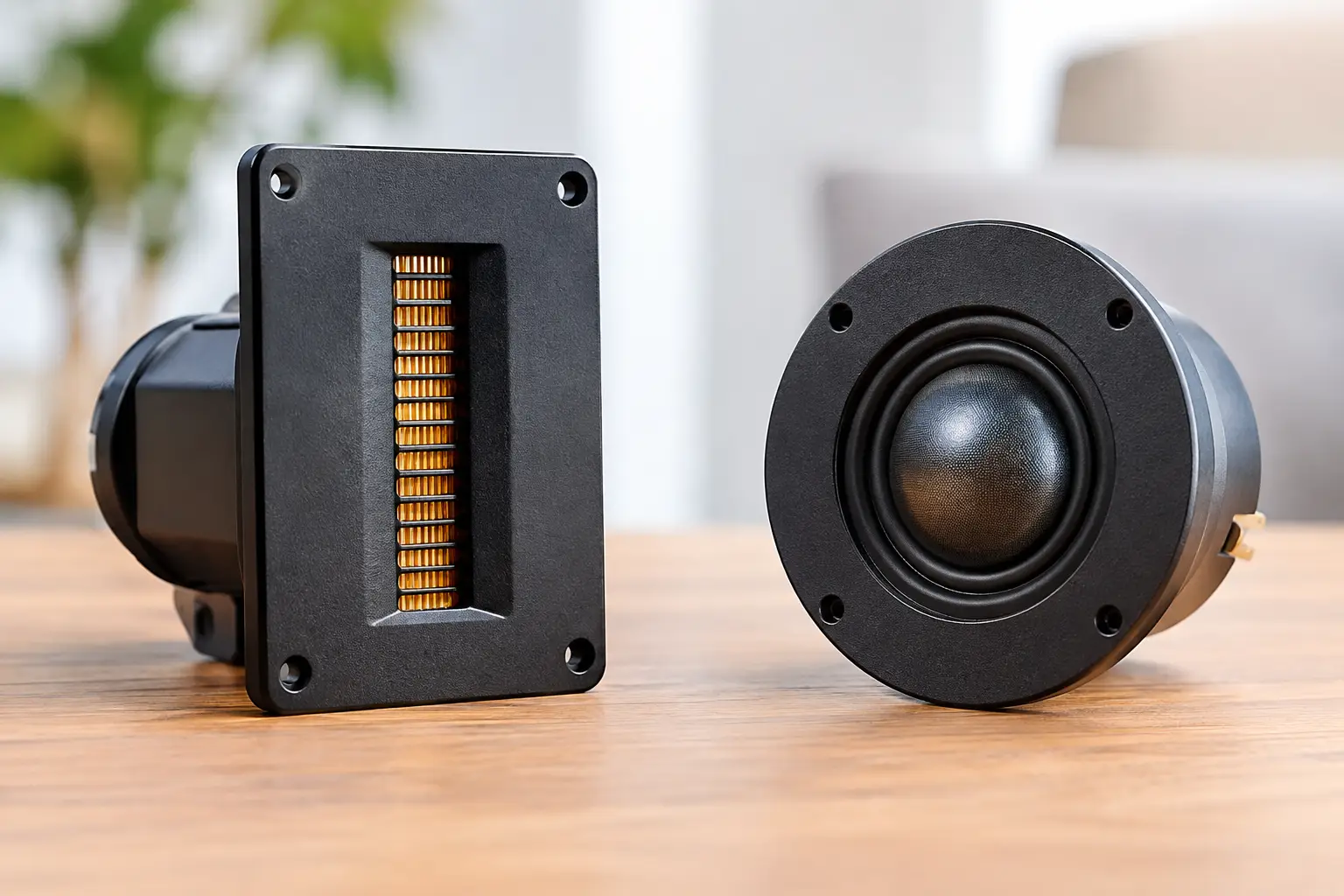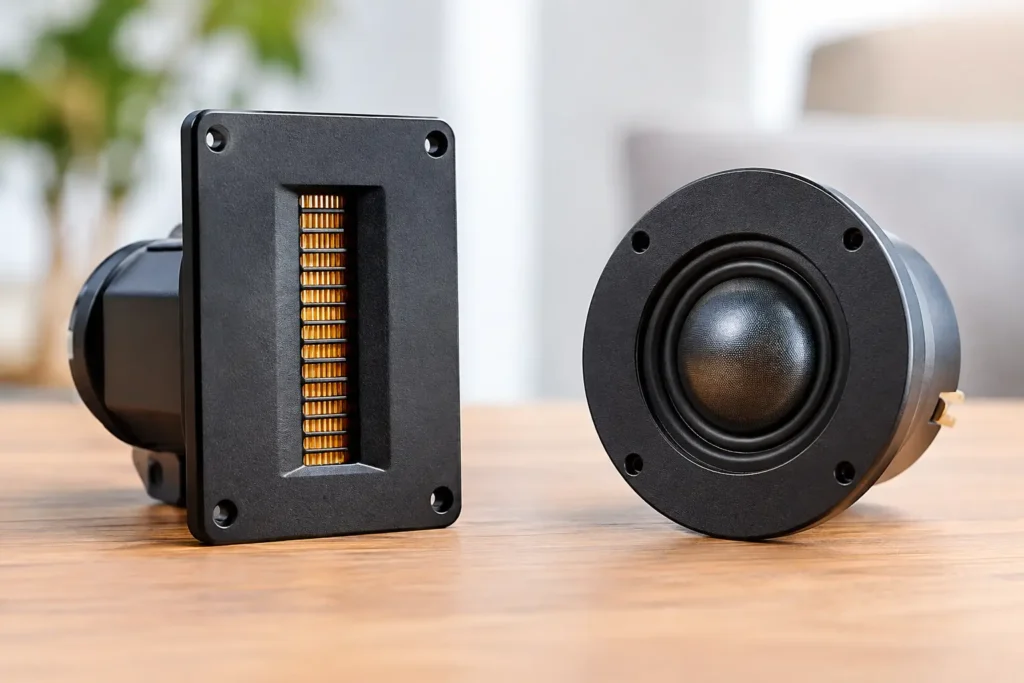
A cymbal is not merely a burst of brightness. In a convincing system, it has a metallic sheen, a decaying halo, and a distinct place behind the vocalist. The question of ribbon versus dome tweeters matters because the tweeter carries these fragile details: the breath at the edge of a phrase, bow rosin on a violin string, the atmosphere of the recording venue. Its contribution can determine whether a loudspeaker sounds merely detailed or genuinely alive.
Neither technology holds an automatic claim to superiority. A ribbon can create remarkable speed and openness; a well-executed dome can offer exceptional coherence, power handling, and tonal ease. What matters is how the driver is engineered, integrated, and voiced within the complete loudspeaker.
Ribbon Versus Dome Tweeters: The Essential Difference
A conventional dome tweeter uses a small, lightweight diaphragm shaped like a dome. A voice coil attached to that diaphragm moves within a magnetic field, pushing air to reproduce high frequencies. Materials vary widely, from silk and other treated fabrics to aluminum, beryllium, ceramic, and advanced composite diaphragms. Each material brings its own balance of damping, stiffness, extension, and character.
A ribbon tweeter works differently. Its radiating element is an extremely thin strip of conductive material suspended in a strong magnetic field. The ribbon itself carries the signal and moves directly, eliminating the separate voice coil found in a traditional dome design. This very low moving mass is the basis for the ribbon’s reputation for speed, delicacy, and exceptional retrieval of fine treble information.
There are also planar-magnetic and air-motion-transformer designs that are often described as ribbons in casual conversation. They share certain qualities, particularly large radiating areas and low-mass diaphragms, but their mechanical operation is not identical to that of a true ribbon. For the listener, the more useful question is not the label alone, but how the chosen treble driver behaves in the room and with the rest of the speaker.
What a Ribbon Tweeter Can Reveal
A fine ribbon tweeter can make the upper registers feel less like sound emitted from a driver and more like air illuminated within the listening space. Microdynamic shifts are often especially persuasive. The faintest touch of a drummer’s brush, the harmonic shimmer of a classical guitar, or the trailing resonance of a piano can arrive with a sense of immediacy that draws the listener deeper into the performance.
Because the ribbon is exceptionally light, it can start and stop with remarkable precision. This does not mean it should sound aggressive or etched. In a refined design, the result is transient clarity without the glare that can turn a long listening session into a technical demonstration. Well matched to a capable midrange driver and crossover, a ribbon may contribute to an expansive, finely layered soundstage.
There are trade-offs. True ribbons can be demanding to implement because their electrical impedance is very low and their output characteristics differ from a conventional dome. They may require careful transformer design, thoughtful crossover choices, and protection from excessive low-frequency energy. Their horizontal and vertical dispersion behavior can also be more directional, depending on the ribbon’s dimensions and installation.
Those traits are not defects. They are engineering realities that ask more from the loudspeaker designer. When handled with skill, they can become part of a distinctive musical presentation: airy, fast, spacious, and revealing without becoming detached from the body of the music.
Why Dome Tweeters Remain Exceptional
The dome tweeter has endured for good reason. It is a mature, versatile technology capable of extraordinary performance. A great soft dome can sound natural, graceful, and beautifully continuous through the presence region, where voices, strings, brass, and much of the emotional fabric of music reside. Its broad dispersion can also support a generous listening window, allowing more than one person to enjoy a balanced tonal presentation.
Metal and hard domes bring a different set of strengths. When designed with proper control of resonance and integrated thoughtfully, they can offer striking extension, precision, and dynamic authority. The best examples avoid the brittle edge sometimes associated with lesser implementations. They preserve the bite of a trumpet or the energy of a live snare drum while retaining tonal discipline.
Dome tweeters are often easier to blend with a wide range of midrange drivers. They can be robust, efficient, and comfortable at higher playback levels, depending on the model and crossover design. For listeners who value scale, dynamic expression, and consistent balance across a room, a dome can be an outstanding choice.
The limitation is not inherent to the dome itself but to execution. A poorly selected or poorly crossed-over dome can sound compressed, splashy, or disconnected. The same is true of any treble technology. No driver escapes the need for sophisticated acoustic design.
The Crossover Decides More Than the Label
Choosing a tweeter in isolation is much like judging a string quartet by hearing only the violin. The final experience depends on the relationship among every component. The crossover frequency, slope, phase behavior, cabinet diffraction, baffle geometry, driver sensitivity, and resonance control all shape what reaches the listener.
The handoff between midrange and tweeter is particularly consequential. Human hearing is acutely sensitive to this region. If the drivers do not blend gracefully, voices may seem to change character as notes rise, and instruments can lose their natural size. A speaker may deliver abundant detail yet fail to convey a believable musical whole.
This is why luxury loudspeaker design is not simply an exercise in selecting prestigious parts. A costly ribbon or exotic dome cannot compensate for a cabinet that stores energy, a crossover that disturbs timing, or drivers that do not share a common tonal language. The art lies in making the system disappear, so the listener encounters the recording rather than its reproduction.
At Gershman Acoustics, this holistic view has long informed the pursuit of musical realism. A loudspeaker should not call attention to its treble driver during a favorite recording. It should preserve the emotional rise of a singer, the scale of an orchestra, and the quiet spaces that give music its intimacy.
Which Sound Suits Your Listening Priorities?
If you are drawn to chamber music, intimate jazz, acoustic recordings, and voices, a ribbon’s delicacy and sense of air may be deeply compelling. It can reveal low-level ambience and textural nuance in recordings you have known for years. On a beautifully captured vocal performance, that added transparency can feel almost physical.
If your listening includes large-scale orchestral works, energetic rock, electronic music, or live recordings played at realistic levels, a dome’s dynamic composure and broad dispersion may be equally attractive. A well-designed dome system can present the leading edge of percussion, the force of brass, and the density of a full arrangement with confidence and poise.
These are tendencies, not rules. An excellent dome can be exceptionally airy. An excellent ribbon can play with impressive authority and weight. Room acoustics, amplifier quality, source components, listening distance, and personal taste will influence the result as much as the technology itself.
Auditioning remains essential. Listen beyond the first impression of extra brightness or apparent detail. Use familiar recordings and pay attention to whether the treble remains composed at low and high volumes. Does a soprano sound human rather than spotlit? Do cymbals decay naturally instead of fizzing? Does the soundstage retain focus when the arrangement becomes complex? Most importantly, do you feel invited to hear one more track?
A Better Standard Than “More Detail”
Treble performance is often reduced to a contest for extension or detail, but those terms can be misleading. A loudspeaker can emphasize the upper range and initially seem more revealing, while actually obscuring tonal colors and recording depth. Genuine resolution is quieter in its confidence. It lets a triangle shimmer without turning every consonant into a spotlight. It allows a violin to soar without becoming glassy.
The finest tweeter is the one that serves the music and remains in balance with the entire loudspeaker. Whether that voice comes from a ribbon or a dome, it should bring you closer to the performance: not impressed by hi-fi effects, but absorbed in the meaning, texture, and emotion of the music itself.
When you audition, give the system time. The right treble presentation is rarely the one that announces itself first. It is the one that keeps revealing the recording’s humanity long after you have stopped thinking about the tweeter.