A great recording can feel startlingly close: the intake of breath before a vocal line, the woody resonance beneath a piano note, the quiet decay of a cymbal long after the strike. Recording studio inspired speakers are designed for listeners who want more than impressive volume or exaggerated detail. They seek the poise, transparency, and emotional truth that allow an exceptional performance to arrive intact in the listening room.
That ambition is not about turning a home into a control room. A recording studio and a fine residence serve different purposes. The former is built to reveal flaws and support decisions; the latter should invite long, absorbing listening. The finest studio-informed loudspeakers respect both realities, combining clarity and tonal discipline with scale, beauty, and the generous musical ease that makes a system part of daily life.
What Recording Studio Inspired Speakers Really Mean
The phrase is often used loosely, so it is worth defining. At its best, a studio-inspired design begins with the values that make professional monitoring meaningful: tonal honesty, low coloration, coherent timing, stable imaging, and an ability to separate musical lines without pulling the music apart.
A loudspeaker with these qualities does not flatter every recording. It reveals the character of the source, from the close-miked intimacy of a jazz trio to the immense architecture of an orchestral work. Yet resolution alone is not the destination. When resolution is divorced from natural tone, music can sound etched, fatiguing, or emotionally remote. When it is properly integrated, detail becomes part of the performance: fingers on strings, air moving through a saxophone, a singer shaping a phrase.
This is the essential distinction between a speaker that sounds analytical and one that sounds convincingly real. The latter gives the listener information without making them listen for it.
Accuracy Should Still Feel Human
In a professional environment, an engineer may need to hear a slight compression artifact or a small imbalance in a mix. At home, those insights can be fascinating, but no one builds a cherished listening system merely to audit recordings. The goal is to hear further into music while preserving its warmth, momentum, and expressive force.
That calls for careful balance. Treble extension must be clean rather than insistent. Midrange presence must illuminate voices without pushing them forward unnaturally. Bass must have authority, but also pitch definition and control. A double bass should sound like a resonant instrument with changing notes, not like a generalized swell of low-frequency energy.
Why the Cabinet Matters as Much as the Drivers
The most sophisticated drivers cannot fully express themselves inside an indifferent enclosure. Cabinet construction is not decorative packaging. It is a critical acoustic element that influences resonance, bass behavior, dynamic composure, and the sense that instruments occupy believable space.
A thoughtfully engineered cabinet resists storing and releasing unwanted energy. This reduces the haze that can blur transients and flatten tonal color. When a piano is reproduced with convincing weight and speed, or when a cello retains its rich body without becoming thick, cabinet control is part of what you are hearing.
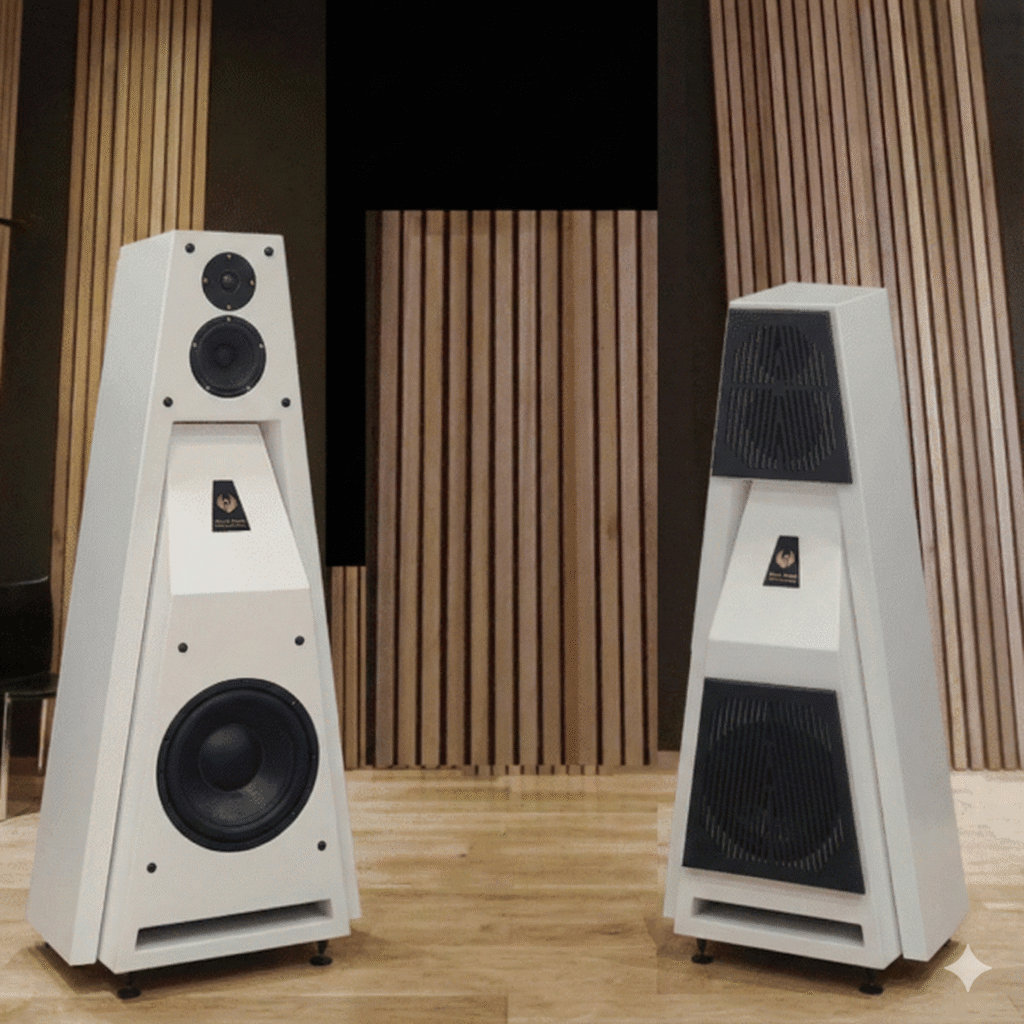
There is also a visual consideration that matters in a luxury home. Loudspeakers occupy physical and aesthetic space, often in rooms designed for conversation, art, and reflection. A large speaker need not feel industrial or intrusive. Fine proportions, careful finishing, and sculptural confidence allow it to belong in the room before the first note begins.
Gershman Acoustics approaches this intersection of acoustic engineering and handcrafted presence as a central part of the listening experience, not as an afterthought.
The Soundstage Is Not a Special Effect
One of the most captivating qualities of recording studio inspired speakers is their ability to establish a convincing soundstage. With a well-recorded performance, the loudspeakers seem to recede. A vocalist gains a defined location and natural scale. Instruments occupy distinct spaces, not as sharply outlined cutouts, but as living bodies surrounded by air.
This depends on far more than left-right width. A believable soundstage has depth, height, and continuity. It lets a listener sense the position of a drum kit behind the singer, the rearward bloom of a concert hall, or the way a guitar amplifier occupies space in a small studio. Just as importantly, the image should remain stable when the music becomes complex. Large ensembles and dense rock productions reveal whether a speaker can maintain order without becoming congested.
Room placement plays a meaningful role here. Even exceptional loudspeakers can lose focus when pressed too close to a wall, placed asymmetrically, or asked to perform in a room with uncontrolled reflections. A careful setup is not a ritual for its own sake. Small adjustments in distance, toe-in, and listening position can transform the relationship between the speakers and the room.
Bass With Authority, Not Theater
Deep bass is often confused with dramatic bass. They are not the same. A speaker may produce a great deal of low-frequency output while obscuring the rhythm section, overwhelming a room, or making every recording sound similarly oversized.
Studio-informed bass should begin and stop with conviction. On an acoustic recording, it should reveal the full scale of a kick drum or the physical bloom of an upright bass. On electronic music, it should deliver pressure and extension without softening the architecture of the beat. On a symphony, it should give timpani and double basses their foundation while leaving room for the rest of the orchestra to breathe.
The size of the room matters. A large floorstanding loudspeaker can be magnificent in an open, generously proportioned space, but its capabilities may be underused in a compact room. Conversely, a smaller design may provide greater coherence and easier integration where placement options are limited. The right choice is not simply the largest model a budget permits. It is the loudspeaker that can energize the room with grace and control.
How to Listen Before You Choose
Technical specifications and reviews can narrow the field, but the final decision should be musical. Bring recordings you know intimately, ideally across several genres and production styles. Choose music with voices, acoustic instruments, dense arrangements, and strong bass. Familiarity allows you to notice whether a speaker is adding a signature of its own.
Listen first for tonal continuity. Does a voice remain natural as it moves from a quiet phrase to a powerful one? Does the transition from bass to midrange feel integrated? Then listen for dynamics. A fine loudspeaker does not merely play loudly. It preserves the small shifts in intensity that make a performance breathe.
Finally, pay attention to fatigue. Initial excitement can be persuasive, particularly when a speaker emphasizes upper-frequency detail or bass impact. After several pieces, however, ask a more revealing question: do you want to keep listening? The most enduring systems make time disappear. They offer enough transparency to reward attention and enough ease to welcome an entire evening of music.
A More Complete Kind of Realism
The appeal of studio-inspired loudspeakers is not nostalgia for equipment racks and control-room glass. It is the promise of greater access to what artists, engineers, and producers worked to preserve. Every recording contains choices about scale, tone, space, and emotion. A loudspeaker of genuine refinement lets those choices speak clearly.
For the discerning listener, that is a luxury with substance. It is found in the quiet confidence of a cabinet built with purpose, the authority of controlled bass, the natural presence of a human voice, and the moment a familiar recording reveals another layer of meaning. Choose the speaker that makes you return to the music, because that is where exceptional sound earns its place in a home.