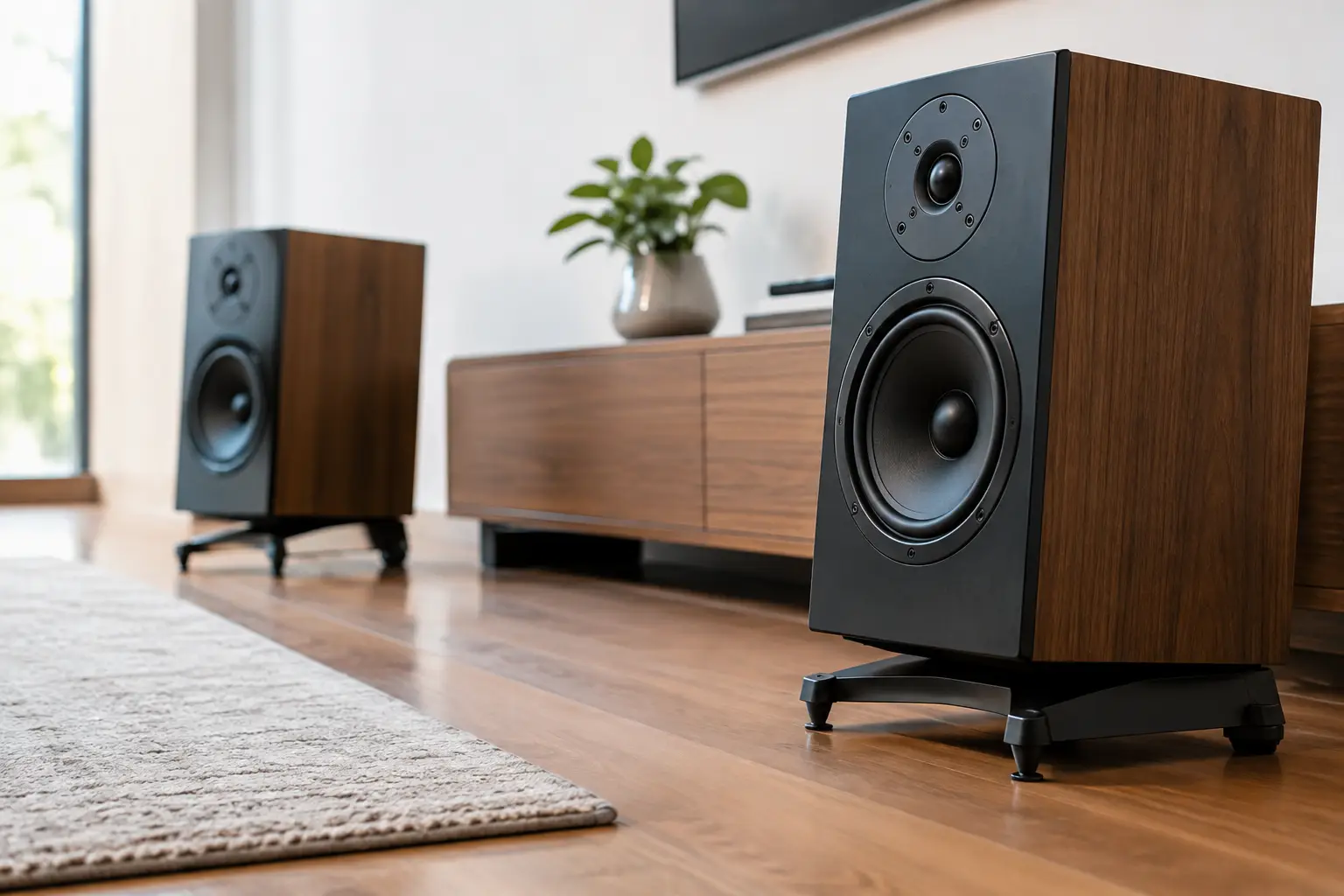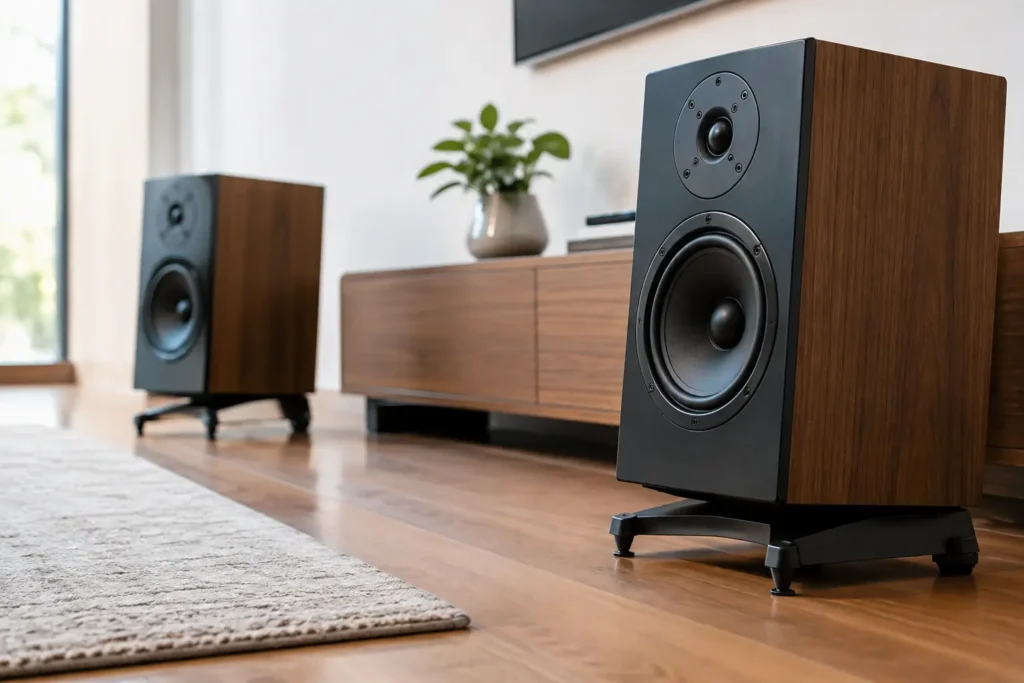
A fine loudspeaker can reveal the breath before a singer begins a phrase, the woody resonance beneath a cello note, and the dimensions of the hall around an orchestra. Yet those qualities can remain partially concealed if the speakers are not aimed with care. Speaker toe adjustment is one of the most revealing refinements available in a serious listening room: a small physical movement that can transform the focus, scale, and ease of the musical presentation.
Toe-in is not an abstract audiophile ritual. It is the angle at which each loudspeaker faces inward toward the listening position. Done thoughtfully, it helps the left and right channels disappear as physical objects, leaving a soundstage that feels continuous, stable, and convincingly alive. Done by habit rather than by ear, it can make an otherwise exceptional system sound narrow, overly brilliant, or strangely detached from the room.
What Speaker Toe Adjustment Changes
Every loudspeaker radiates sound differently. Its energy does not spread identically at every frequency, and the room contributes reflections from sidewalls, furnishings, floors, and ceilings. Toe-in changes the relationship between the direct sound reaching the listener and the reflected sound arriving fractions of a second later.
With more toe-in, the listener receives more of the loudspeaker’s on-axis output. This often produces sharper image outlines, stronger center focus, and greater clarity in low-level details. A vocalist may appear precisely centered between the speakers rather than occupying a broad, indistinct region. The trade-off is that some systems can sound more forward or more concentrated when aimed aggressively at the seat.
With less toe-in, more of the speaker’s off-axis character and more room energy enter the picture. The stage may spread wider and the tonal balance may feel more relaxed. In the right room, this can be wonderfully natural, especially with recordings that already possess generous spatial information. Too little toe-in, however, can soften image placement and leave the center image less convincing.
The aim is not maximum width or maximum precision in isolation. It is a believable musical whole: tonal colors that remain true, performers placed with assurance, and a stage that opens without becoming artificial.
Begin With Symmetry, Not Guesswork
Before changing angles, establish a sensible foundation. Position the speakers so their distance from the primary listening chair is approximately equal to the distance between them. This is a starting geometry, not a law. A room, a loudspeaker’s dispersion pattern, and the listener’s priorities will determine the final result.
Ensure the pair is symmetrical relative to the room as far as practical. One speaker positioned much nearer a sidewall than the other will hear a different acoustic environment, and toe adjustment alone cannot fully correct that imbalance. Check that both cabinets are stable, level, and at an equivalent distance from the front wall. These fundamentals preserve the stereo relationship encoded in the recording.
Choose one listening position for the process. If a room serves several listeners, optimize first for the primary seat, then broaden the result where possible. A system designed for critical listening will rarely deliver exactly the same image at every point on a large sofa. That is not failure. It is simply the nature of two-channel reproduction.
A Listening Method That Reveals the Difference
Begin with the speakers aimed nearly straight ahead, or with only modest inward angle. Then move each speaker in equal increments, preserving its distance from the listening seat. A practical first adjustment is a small rotation of a few degrees inward. Listen before making another change.
Use familiar music with a naturally recorded voice, uncompressed piano, small acoustic ensemble, or well-captured jazz trio. The best tracks for this purpose are not necessarily the most spectacular. They are recordings whose timbre and spatial cues you know deeply enough to recognize when something shifts.
Listen for the center image first. A properly formed vocal should have body and dimensionality, not merely a pinched point between the cabinets. Then listen beyond the vocal: do instruments occupy stable locations? Does the acoustic space extend behind the speakers? Is there air around a cymbal, a violin section, or a softly played piano?
Make one change at a time and live with it for several tracks. Quick comparisons are useful, but the most convincing setup often reveals itself after the initial novelty fades. If a change makes a solo voice more explicit but drains warmth from strings or makes dense passages feel tense, it may be too extreme.
A simple way to maintain consistency is to place a small piece of removable tape on the floor at each front corner of the speaker. Mark the previous position before rotating the cabinet. This allows you to return to a setting that felt more musically persuasive without relying on memory.
When the Speakers Cross in Front of You
Some listeners prefer a more pronounced toe-in, with the axes of the loudspeakers crossing slightly in front of the listening position. This can reduce the influence of sidewall reflections and produce exceptionally focused imaging. It may also create a wider area of balanced sound for listeners seated near the center, depending on the speaker design.
Other systems sound most open when their axes meet at, or just behind, the listening seat. This approach can preserve a broad stage and a more relaxed perspective. Neither method is universally superior. The correct choice is the one that lets voices sound human, instruments retain their natural scale, and the recorded venue emerge without exaggeration.
Read the Room Along With the Music
A highly reflective room often benefits from greater toe-in because it reduces the relative level of early sidewall reflections. Large expanses of glass, hard floors, and bare walls can create a bright, diffuse presentation that blurs image boundaries. Rugs, drapery, books, and thoughtfully placed furnishings may be as meaningful as another degree of rotation.
In a heavily furnished or acoustically damped room, too much toe-in can sometimes make the sound feel overly direct. A little less angle may restore openness and ease. The room should support the loudspeaker rather than impose a signature of its own.
Speaker design matters as well. Models with controlled dispersion may tolerate or even reward more direct aiming, while speakers designed for broad off-axis response can remain coherent with less toe-in. Cabinet placement near boundaries, driver height, and the character of the recording all influence the result. This is why inherited rules such as “always aim speakers directly at your ears” are too blunt for a refined system.
Signs You Have Gone Too Far
The most common mistake is to pursue image sharpness until the sound loses its natural scale. Excessive toe-in can create a center image that is impressively exact yet too small, too insistent, or tonally overlit. Brass may gain edge, sibilants may become conspicuous, and a large orchestra may contract toward the middle.
Insufficient toe-in has its own signature. The stage may seem broad but vague, with a voice that drifts as pitch changes or as the arrangement becomes dense. Transient details can feel softened, and the loudspeakers may remain audibly present rather than disappearing into the recording.
The finest setting often sits between those extremes. It gives a singer a stable location without turning the singer into a cutout. It allows a symphony orchestra to expand beyond the cabinets while retaining convincing rows of depth. It makes a modestly recorded album enjoyable rather than exposing every limitation with clinical severity.
The Last Degree Belongs to Your Ear
At Gershman Acoustics, the pursuit of musical realism has always recognized that a loudspeaker and a room form a relationship. Handcrafted loudspeakers can deliver remarkable scale, tonal refinement, and image integrity, but placement gives those virtues their final voice within a home.
Do not feel compelled to finish speaker toe adjustment in one evening. Return to it over several listening sessions and with different genres. A setting that flatters a close-miked vocal may not serve a full orchestral recording with the same grace. The right compromise should make you less aware of adjustment and more absorbed in performance.
When the angle is right, the reward is quietly unmistakable. The cabinets recede, the room seems to enlarge, and music gains the unforced presence of something happening rather than something reproduced. Leave the tape marks in place for a few days, trust the response that keeps inviting you back to another record, and let the final degree of toe-in be decided by the emotion of the music.