A late-night vocal recording can expose an amplifier’s character more clearly than a page of specifications. The breath before a phrase, the weight of a piano’s left hand, the decay of a cymbal into silence – these are the moments that make the discussion of tube amplifiers versus solid state meaningful. Neither approach is automatically superior. The more rewarding question is which amplifier allows your loudspeakers, room, and musical priorities to feel most alive.
For a serious music system, amplification is not merely a source of watts. It is the partnership between source and loudspeaker that determines tonal color, dynamic freedom, soundstage scale, and the sense that performers occupy a believable acoustic space in the room.
Tube Amplifiers Versus Solid State: The Essential Difference
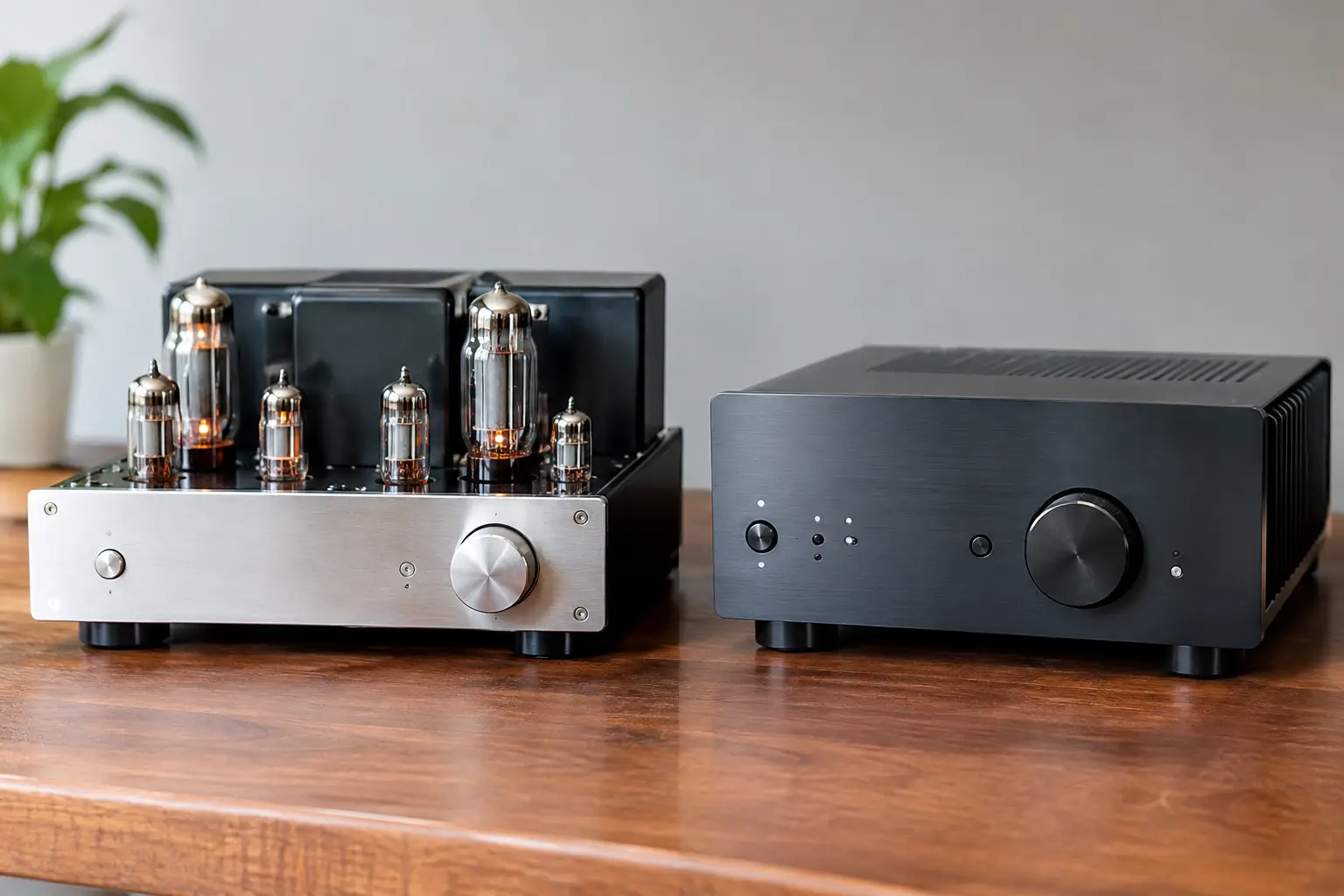
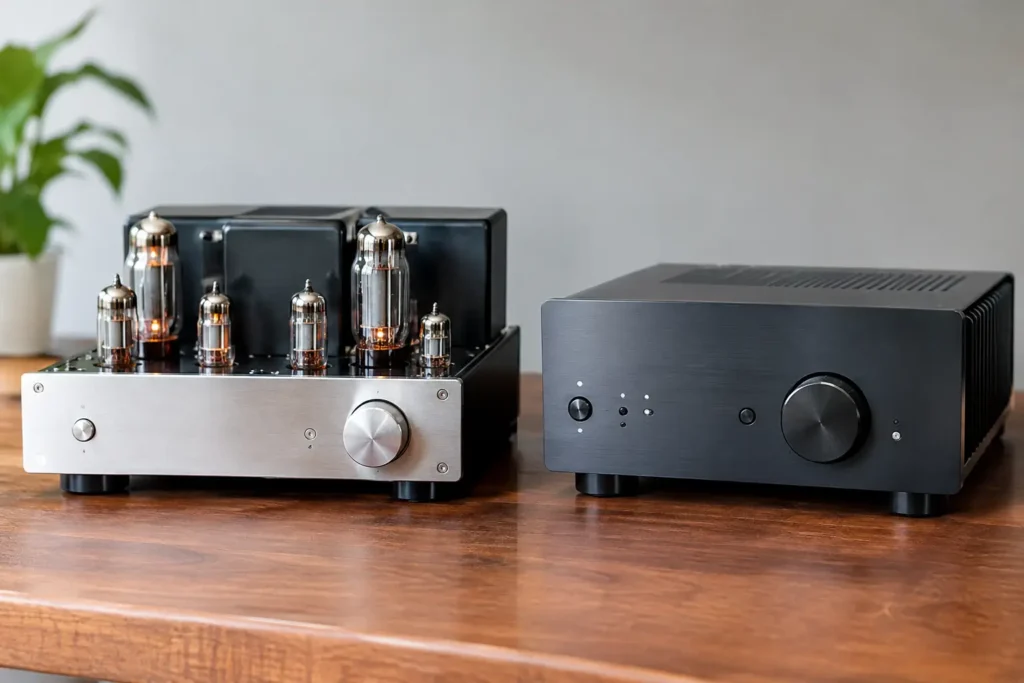
Tube amplifiers use vacuum tubes to amplify an audio signal. Solid-state amplifiers use transistors, whether bipolar devices, MOSFETs, or other semiconductor designs. That distinction is simple. What listeners hear, however, is shaped by far more than the active device itself: circuit topology, power supply design, output transformers, biasing, parts quality, and the designer’s ear all matter enormously.
Still, broad tendencies do exist. A well-executed tube amplifier is often prized for tonal density, dimensionality, and a graceful presentation of harmonics. Voices can feel present and human, strings can carry more texture, and intimate recordings may seem to breathe with unusual ease. This is not a euphemism for soft or vague sound. The finest tube designs can be remarkably transparent, provided they are matched to suitable loudspeakers.
Solid-state amplification is frequently admired for control, extension, speed, and low-frequency authority. With a capable design, bass notes begin and stop with conviction, large orchestral crescendos remain composed, and difficult loudspeaker loads are handled without strain. Modern solid-state amplifiers can also deliver exceptional tonal refinement and soundstage depth. The old assumption that every transistor amplifier sounds cool or mechanical is as outdated as the belief that every tube amplifier sounds warm and romantic.
The meaningful distinction is not warmth versus detail. It is how an amplifier organizes energy, tone, and dynamics under real listening conditions.
Why Tube Sound Remains So Compelling
A tube amplifier can bring a distinct sense of ease to music, especially through the midrange. On a finely recorded jazz quartet, the saxophone may carry a burnished, corporeal presence rather than appearing as a sharply outlined image between the speakers. On chamber music, the relationship between bow, string, and resonant wood can feel more continuous. Many listeners describe this quality as musicality, though the word is often used too casually.
Part of the appeal comes from the way many tube circuits handle harmonic structure and overload. When pushed beyond their limits, tubes often distort more gently than many solid-state circuits. In practical terms, this can make a tube amplifier feel relaxed and spacious at normal listening levels, even when its measured power rating is modest.
That does not mean tube power is interchangeable with solid-state power. A 35-watt tube amplifier may sound surprisingly authoritative with an efficient loudspeaker, yet it may not be suitable for a large room, demanding bass-heavy music, or speakers whose impedance drops sharply at certain frequencies. Output transformers, tube condition, and speaker behavior all influence the outcome.
Tube ownership also has a tactile appeal that belongs naturally in a considered listening room. The subtle glow of valves, the ritual of warm-up, and the possibility of tailoring a system through carefully selected tubes create a more personal relationship with the component. For some collectors, this is part of high-end audio’s enduring pleasure. For others, it is an unnecessary complication.
The Case for Solid-State Authority
Solid-state amplification has earned its place in reference systems for good reason. Its greatest advantage is often current delivery. Loudspeakers do not present a fixed, simple resistance to an amplifier. Their impedance changes across the frequency range, and the amplifier must maintain composure as the musical signal becomes more demanding.
A powerful, thoughtfully designed solid-state amplifier can exert exceptional control over woofer motion. The result is not simply more bass. It is bass with shape, pitch, and start-stop precision. A double bass can retain its woody resonance while remaining clearly distinct from a kick drum. A full orchestra can expand without the lower registers becoming congested.
Solid-state designs are also compelling for listeners who enjoy wide-ranging repertoire at realistic levels. Electronic music, large-scale symphonic works, rock, and recordings with substantial low-frequency information often benefit from generous reserves of power and current. In a larger room, that headroom can preserve scale and clarity when the music becomes complex.
Practical ownership is another consideration. Solid-state amplifiers generally require less routine maintenance, do not need replacement output tubes, and are often ready to perform at a moment’s notice. A premium solid-state amplifier can provide years of consistent service with minimal intervention, which has genuine value in a system designed for daily use.
The Loudspeaker Decides More Than Most People Expect
Choosing between tubes and transistors without considering the loudspeaker is one of the costliest mistakes in high-end audio. Sensitivity is a useful starting point, but it is not the whole story. Impedance behavior, phase angle, crossover complexity, room size, and desired listening level can be just as significant.
An efficient loudspeaker with a benign impedance curve may reveal the beauty of a modestly powered tube amplifier: vivid tonal colors, generous image depth, and an effortless sense of flow. A loudspeaker with demanding low-impedance regions may flourish with a substantial solid-state amplifier that can provide the necessary grip and dynamic stability.
Yet specifications alone cannot predict the emotional result. Some sophisticated tube amplifiers possess enough bandwidth and transformer quality to control speakers more confidently than expected. Some high-current solid-state amplifiers possess a richness and liquidity that surprise listeners accustomed to older designs. The only reliable answer is to listen to the particular pairing with music you know deeply.
At Gershman Acoustics, loudspeaker performance is approached as a complete musical experience rather than an isolated measurement. A well-matched amplifier should allow the cabinet, drivers, crossover, and room to disappear, leaving the listener with the spatial and emotional truth of the performance.
Consider the Room and the Way You Listen
The ideal amplifier is shaped by lifestyle as much as technology. If your listening is centered on late-evening vocal jazz, solo piano, acoustic folk, and small ensembles, a tube amplifier may offer exactly the intimacy and tonal expression you seek. If your room is expansive and your musical life includes Mahler, stadium-scale rock, or electronic recordings played with convincing physical impact, solid-state power may be the more natural foundation.
Volume matters, but so does the character of low-level listening. Some systems remain emotionally engaging when played quietly, while others need more level before the soundstage opens and rhythmic energy arrives. A superb amplifier should not make every recording sound alike. It should reveal the differences among recordings while preserving musical coherence.
Your room’s acoustic character also deserves attention. A bright, minimally furnished space can exaggerate certain qualities in any system. A heavily damped room can rob music of life and air. Before blaming tubes or transistors for a system that feels thin, boomy, or closed-in, assess speaker placement, seating position, and basic room balance. Amplification can refine a system, but it cannot fully overcome an unsuitable setup.
Ownership Trade-Offs Worth Respecting
Tube amplifiers ask more of their owners. Tubes age, generate heat, and may eventually need replacement. Some designs require bias checks, while others simplify maintenance through auto-bias operation. The cost and availability of favored tube types can also vary considerably. These are manageable realities, not reasons to avoid tubes, but they should be part of an informed decision.
Solid-state amplifiers are typically easier to live with, although they are not universally better suited to every home. High-powered models can be heavy, run warm, and demand thoughtful placement. Some are also revealing enough to expose weaknesses elsewhere in the system. Convenience should never be confused with indifference to system matching.
Budget deserves similar honesty. A lower-powered tube amplifier built with excellent transformers and premium parts may cost more than a muscular solid-state alternative. Conversely, a truly accomplished high-current solid-state amplifier can represent a major investment. Buy for the quality of the complete partnership, not the romance of a technology or the number printed beside its power rating.
Listen for Connection, Not Camp Loyalty
Audition with familiar recordings that challenge different aspects of reproduction. Bring a voice whose phrasing you know, an acoustic bass line with real pitch variation, a densely arranged orchestral passage, and a recording that makes you want to turn up the volume. Listen beyond first impressions. A brighter presentation can initially seem more detailed; a richer one can initially seem more inviting. Over time, the better amplifier usually reveals itself through less fatigue, stronger musical continuity, and a deeper desire to keep listening.
Do not let the tube-versus-solid-state debate become a matter of allegiance. The finest systems are assembled with discernment, curiosity, and respect for the music. Choose the amplifier that makes your loudspeakers communicate with greater conviction, then give yourself an unhurried evening with an album you love. If the system draws you past analysis and into the performance, you have found something worth keeping.