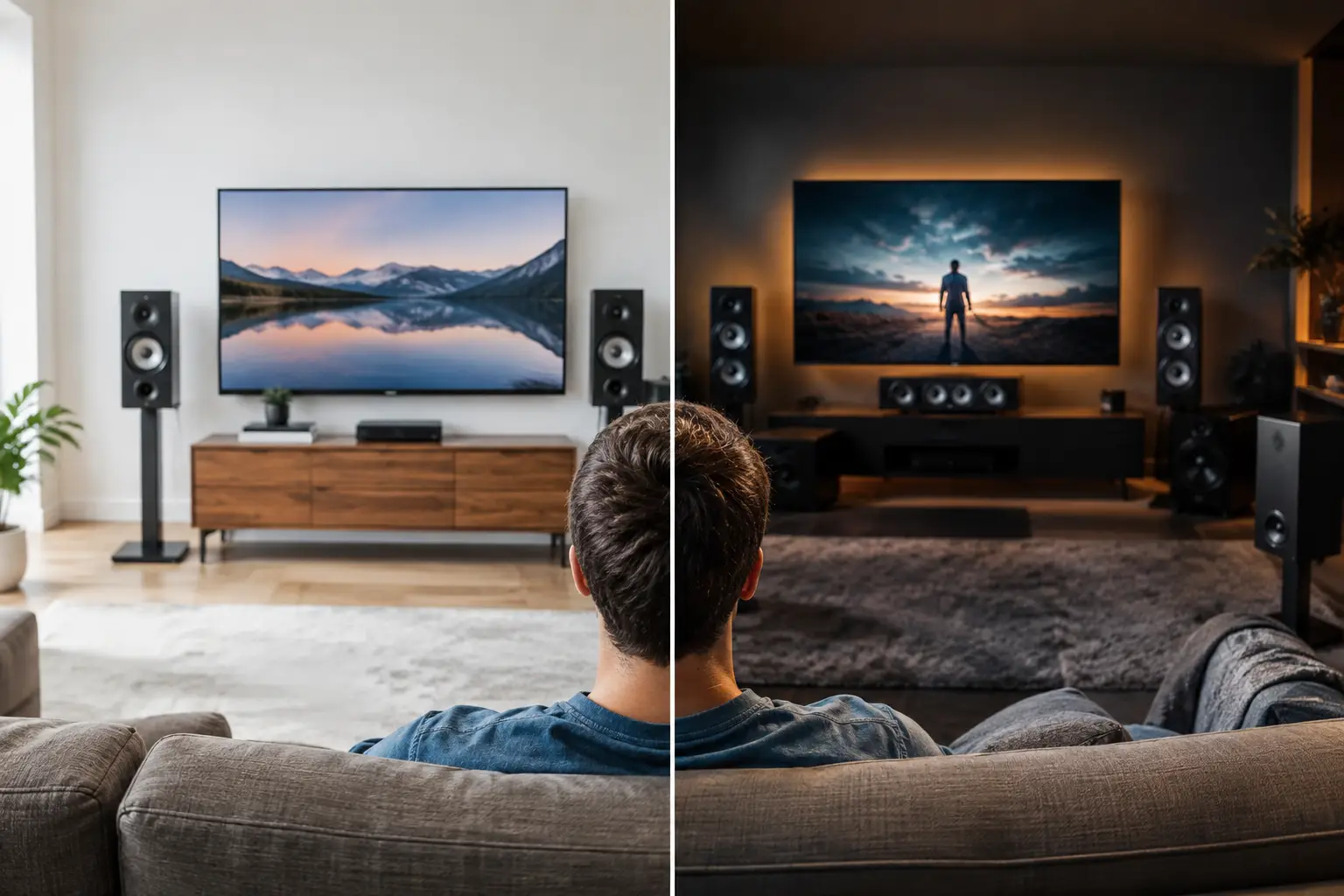
A great recording can make a room disappear. A vocalist seems to occupy a precise, breathing space between the loudspeakers; a piano has weight, scale, and an unmistakable sense of touch. Yet when planning a reference-quality home system, the question of two channel versus surround often arrives with an assumption: surely more speakers must create a more convincing experience.
Not necessarily. Two-channel stereo and surround sound pursue immersion by different means. One can reveal the emotional architecture of a performance with extraordinary coherence. The other can place you within the atmosphere of a film, concert, or multichannel recording. The right choice is not about speaker count. It is about the material you cherish, the room you live in, and the kind of attention you want to give music.
Two Channel Versus Surround: Different Ideas of Immersion
A two-channel system uses a left and right loudspeaker to create a soundstage in front of the listener. When the loudspeakers, room, and recording are working together, the result is far more dimensional than the term “two channel” suggests. Instruments can appear across a broad stage, voices can lock into a stable center image, and the recorded acoustic can extend well beyond the physical boundaries of the speakers.
This illusion depends on precision. Tiny differences in timing, level, phase, and tonal balance tell the ear where a sound belongs. A well-designed pair of loudspeakers preserves those cues so convincingly that the listener does not hear two boxes producing sound. The listener hears a performance taking shape in space.
Surround systems use additional channels around, above, and sometimes below the listening position. Their purpose is not merely louder playback or more bass. They create a wider field of information: an orchestra hall’s reverberation, rain moving overhead, a crowd behind the viewer, or the carefully placed effects of a cinematic soundtrack. In the finest installations, surround can be enveloping without becoming distracting.
The difference is philosophical as much as technical. Stereo often asks you to face the performance. Surround can place you inside the environment that contains it.
Why Two Channel Still Holds a Special Place for Music
Most commercial music has been mixed for stereo. That includes an enormous catalog of jazz, classical, rock, folk, blues, electronic, and vocal recordings, as well as countless modern high-resolution releases. For the listener whose primary ritual is sitting with an album, a dedicated two-channel system remains one of the most direct paths to musical truth.
The appeal is not simplicity for its own sake. It is concentration. With two exceptional loudspeakers, a carefully selected amplifier, and a source worthy of the recording, the system can devote its full attention to tone, timing, dynamics, and imaging. There is no need to compromise the main left and right channels around the demands of a larger installation.
This matters because the front pair carries the emotional heart of nearly every stereo recording. A string quartet requires delicacy and harmonic color. A live drum kit demands speed, impact, and realistic decay. A great singer needs to sound human rather than enlarged, etched, or artificially sweetened. These qualities are not accessories to music reproduction. They are the experience.
Two-channel systems can also be visually serene. A pair of beautifully crafted floorstanding loudspeakers has presence, but it does not need to dominate a room with visible speaker positions on every wall. For design-conscious homes, that restraint can be part of the luxury. The system becomes a considered piece of architecture and furniture, as well as an instrument for listening.
The Stereo Sweet Spot Is Real, but It Is Not a Flaw
Stereo is at its most holographic from a defined listening position, often described as the sweet spot. Move well to one side and the center image may shift toward the nearer loudspeaker. This is a genuine limitation, particularly in rooms designed for conversation or casual entertaining rather than dedicated listening.
But a thoughtfully engineered loudspeaker can create an expansive, stable presentation that remains engaging across more than one seat. Room placement, speaker dispersion, and careful setup matter greatly. The goal is not to chase a laboratory-perfect triangle at the expense of living comfortably. It is to create a room where music has believable scale and focus whenever you choose to listen closely.
When Surround Sound Is the Better Choice
For cinema, surround is not a luxury add-on. It is part of the language of the soundtrack. Dialogue is usually anchored to the center channel, while music, ambience, and effects are distributed around the room to establish scale and motion. A well-calibrated surround system can make a great film feel more involving without turning the home into a commercial theater.
Surround is also compelling for gaming, live concerts, and the growing library of multichannel and immersive music. Recordings mixed in Dolby Atmos or other immersive formats can reveal details and spatial relationships unavailable in a conventional stereo mix. A choir may bloom around the room. Studio textures may float above the listener. A concert audience can feel less like a backdrop and more like a living presence.
There are trade-offs. A serious surround system requires more loudspeakers, more amplification channels, more cable management, and more attention to calibration. The center speaker must integrate naturally with the left and right channels, or dialogue can sound detached from the image. Surround and height channels should have compatible tonal character, or a sound moving through the room can change color as it travels.
This is why surround should never be treated as a collection of unrelated products. The best results come from a coherent system, thoughtfully positioned and tuned for the room. More channels can create more magic, but they also create more opportunities for imbalance.
Room Design Changes the Answer
The room often decides the two-channel versus surround question before the equipment does. A dedicated media room with controlled lighting, flexible seating, and walls that can accommodate speakers naturally invites a surround installation. It can be designed around a screen, with speaker locations and acoustics considered from the start.
A formal living room, library, or open-plan space may favor stereo. Two loudspeakers can be positioned with enough breathing room to develop a convincing stage while preserving the visual calm of the interior. In such rooms, adding five, seven, or more visible speakers may dilute both the sonic focus and the design intention.
Acoustics deserve equal attention. Bare glass, stone, and large reflective surfaces can make any system sound hard or unsettled. Thick rugs, upholstered furniture, drapery, books, and considered wall treatments can bring greater clarity without making a room feel technical. The most successful listening rooms are often the ones where acoustic intelligence has been integrated quietly into an elegant interior.
Do Not Confuse Bass With Surround
Low-frequency performance is frequently discussed alongside surround sound, but the two are separate decisions. A full-range stereo loudspeaker can deliver profound, controlled bass and convincing orchestral scale on its own. Conversely, a surround system may benefit from one or more subwoofers for the lowest cinematic effects and more even bass throughout several seats.
The question is not whether bass should be felt. It should. The question is whether it arrives with speed, definition, and proportion. Excess bass can make a system impressive for a few minutes and exhausting over an evening. Proper integration allows a double bass, pipe organ, kick drum, or film score to carry genuine authority without obscuring the musical line.
The Value of Building Around the Main Pair
For many discerning listeners, the most satisfying approach is to begin with uncompromised two-channel performance. Invest in loudspeakers capable of resolving the texture, space, and dynamic life of recordings, then build the rest of the system around their character. If cinema becomes a priority later, a compatible center channel, surrounds, subwoofers, and processing can be added with intention.
This approach protects the quality of everyday listening. It recognizes that music is often played for hours, while films may be watched less frequently. It also allows the main loudspeakers to remain the visual and sonic center of the room. At Gershman Acoustics, that devotion to the emotional realism of the musical event is central to the purpose of a handcrafted loudspeaker.
There is, of course, no universal hierarchy. A film enthusiast with a dedicated theater may rightly choose surround first. A collector who spends Sunday afternoons with records may find that two exceptional channels offer more lasting reward than a larger but compromised system. The ideal answer is personal, and it should remain so.
Before choosing, spend time with the recordings and films that matter to you. Listen for the natural size of a voice, the decay of a cymbal, the silence around a piano, and the way a room full of sound either invites you closer or asks you to leave. Choose the system that makes you want to stay for one more track.