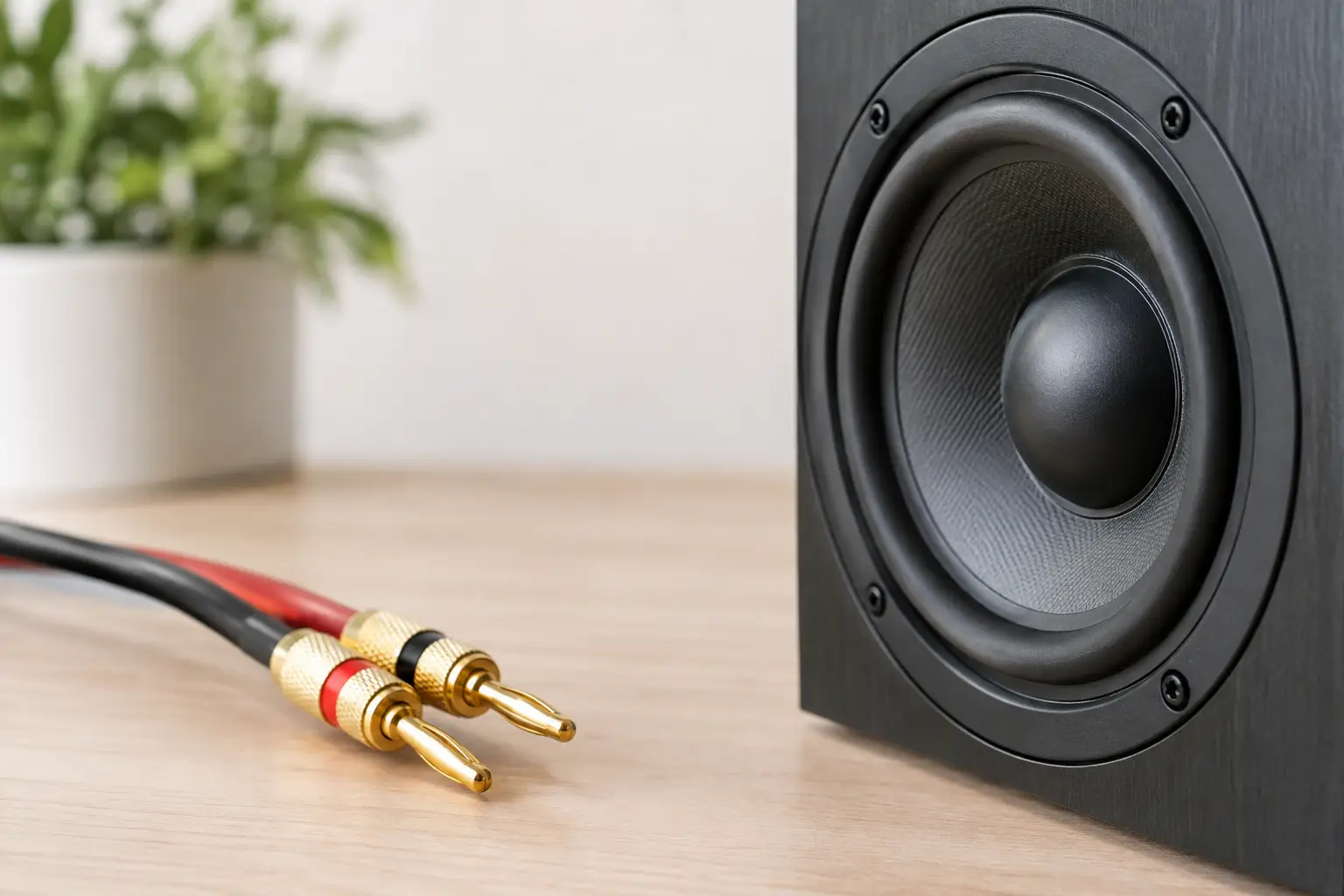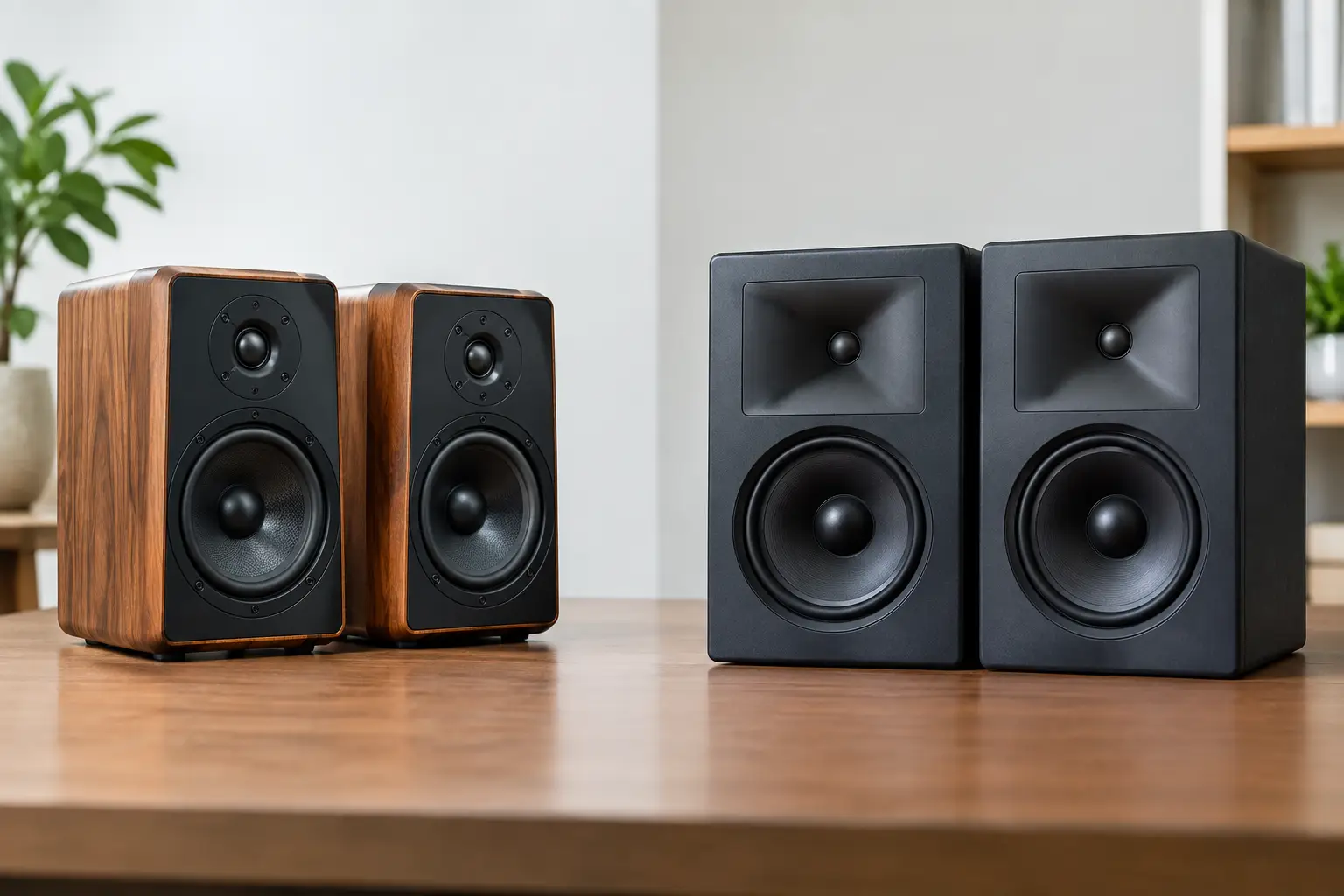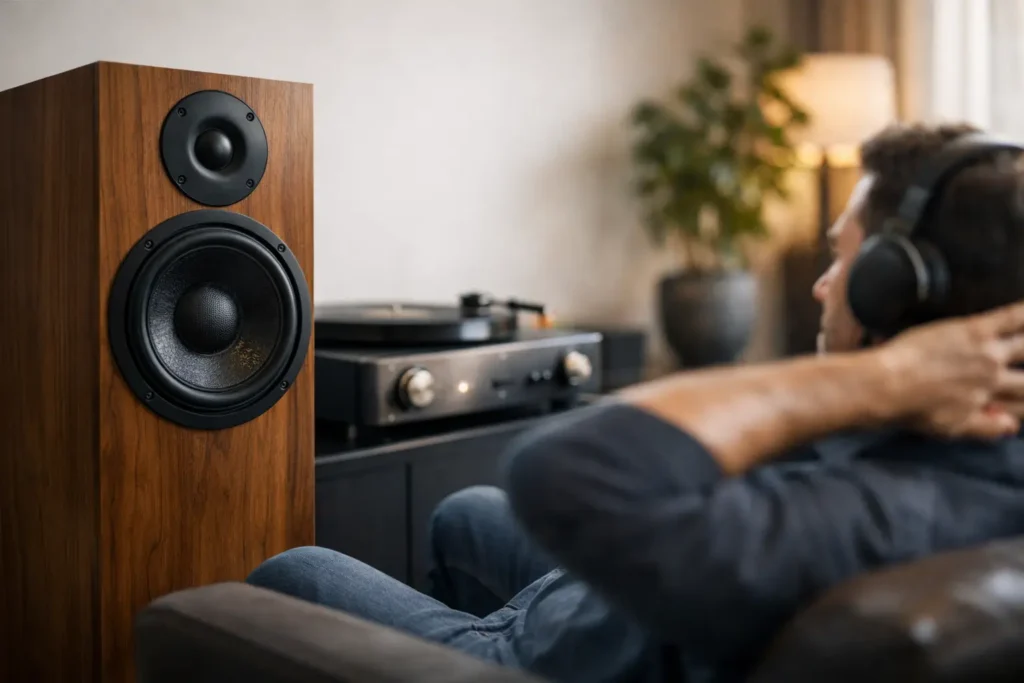
A newly installed loudspeaker can be an arresting experience from the first note, yet its full voice may not arrive all at once. This guide to speaker break in is for listeners who want to approach those first hours with patience, judgment, and respect for the music. A fine loudspeaker is not a laboratory specimen to be punished with noise. It is an instrument of reproduction, designed to make a recording feel present, dimensional, and emotionally complete.
What Speaker Break In Actually Means
Speaker break in refers to the settling period that occurs as a new loudspeaker is played. Its moving components, especially the woofer and midrange suspensions, begin operating through their normal range of motion. Over time, the surround and spider can become more compliant, which may slightly affect bass extension, low-frequency ease, and overall integration.
The degree of change varies. A compact monitor with modest bass output may show less obvious evolution than a full-range floorstander with large drivers and substantial low-frequency capability. Some changes are mechanical; others are perceptual. Your ears and your familiarity with the system also develop as you learn a new speaker’s balance, scale, and way of presenting space.
That distinction matters. Break in should never be used to excuse a fundamental mismatch in speaker placement, room acoustics, amplifier control, or personal taste. If a system sounds aggressively bright, congested, or bass-heavy from the outset, the answer may be positioning or setup rather than simply waiting for hundreds of hours to pass.
A Guide to Speaker Break In Without the Ritual
The most effective method is also the most civilized: play music you enjoy at realistic, moderate levels. Let the loudspeakers work as they were intended to work, reproducing a broad range of instruments, voices, transients, and dynamics. Well-recorded jazz, orchestral music, acoustic ensembles, vocal recordings, and thoughtfully produced rock can all be excellent choices because they exercise the system naturally.
For most premium loudspeakers, the first 50 to 100 hours are enough to reveal the greater part of any mechanical settling. Further refinement can continue beyond that point, particularly in bass control and ease at higher dynamic levels, but it is rarely productive to monitor every hour for a dramatic transformation. Listen in sessions. Return to familiar recordings after several days. Notice whether a stand-up bass carries more pitch definition, whether a piano’s weight feels more convincing, or whether voices gain a more relaxed, unforced presence.
There is no advantage in playing a new speaker loudly for days on end. Excessive volume does not make the process more elegant or more certain. It can overwhelm a room, strain an amplifier, and make thoughtful listening impossible. Moderate playback with occasional dynamic passages is sufficient. If you are leaving the system unattended, keep levels conservative and avoid material with extreme low-frequency energy.
Some owners use pink noise, frequency sweeps, or dedicated break-in tracks. These can move drivers across a broad operating range, but they are optional rather than essential. They also offer little of the pleasure that motivated the purchase in the first place. Music is usually the better choice. The goal is not to force a component into submission; it is to allow a carefully engineered loudspeaker to settle into a life of listening.
What You May Hear as Hours Accumulate
Early impressions often center on the bass. At first, low frequencies can seem slightly restrained, tight, or less freely extended than expected. As the drivers settle, bass may become more articulate and physically convincing, with clearer distinctions between the resonance of a cello, the body of a kick drum, and the lowest register of an orchestra.
The midrange may also seem to breathe more easily over time. This is not necessarily a wholesale change in tonal character. Rather, dense passages can begin to feel less constrained, allowing the natural color of strings, brass, woodwinds, and the human voice to emerge with greater continuity. Imaging may become more stable as well, though placement and room symmetry remain far more influential than break in alone.
Treble is an area where patience and perspective are especially valuable. A new speaker can initially appear vivid because it reveals detail that a previous system softened or concealed. Before concluding that the top end is excessive, confirm the speakers are not toed in too aggressively, positioned too close to reflective surfaces, or paired with electronics that emphasize the same region. Give both the system and your ears time, then make one adjustment at a time.
Setup Still Matters More Than Break In
No break-in process can compensate for careless placement. Even the most accomplished loudspeaker needs space to create a believable soundstage and to let its bass integrate with the room. Begin with the manufacturer’s guidance, then refine placement gradually. Moving a speaker a few inches can alter bass weight, image focus, and tonal balance more profoundly than many hours of additional playback.
The listening position deserves the same care. A symmetrical arrangement is an excellent starting point, but rooms are rarely perfect. Experiment with distance from the front wall, speaker separation, and toe-in while using recordings whose vocal placement and acoustic ambience you know intimately. Seek coherence rather than spectacle. An exaggeratedly wide stage may be impressive for a moment, but it is less satisfying than a stable image with natural scale and believable depth.
Amplification is equally relevant. A loudspeaker does not need to be played loudly to break in, but it does benefit from an amplifier with adequate current delivery and control. Underpowered electronics driven into strain can harden the sound and confuse the evaluation. Conversely, a composed amplifier allows the speaker’s dynamic shading, tonal textures, and rhythmic authority to emerge at sensible levels.
Give Your Ears a Fair Reference
A useful approach is to select three or four recordings you know deeply and revisit them periodically. Choose music with a naturally recorded voice, a sparse acoustic instrument, a piece with controlled bass, and a larger-scale recording. Do not analyze every second. Listen for the feeling of musical flow: whether rhythms hold together, whether a singer sounds embodied rather than flattened, and whether you remain drawn into the performance rather than distracted by the system.
Avoid changing cables, source components, room treatments, and speaker positions all at once during the first week. Multiple changes create a moving target. If you wish to optimize the system, establish a baseline, make a single adjustment, and live with it long enough to understand its effect. This measured process is more revealing than an endless chase for a theoretical ideal.
For owners of handcrafted loudspeakers such as Gershman Acoustics, break in is best regarded as the beginning of a long relationship with the system. The cabinet, crossover, drivers, and finish represent deliberate choices in service of musical realism. They deserve to be heard in a room that has been considered with equal intention.
When to Ask for Help
A speaker should not produce buzzing, scraping, intermittent output, or obvious distortion at normal listening levels. Those are not signs of break in. Nor should one channel sound dramatically different from the other after basic setup has been checked. In these situations, stop trying to diagnose the issue through additional playback and consult your authorized dealer or the manufacturer.
It is also reasonable to seek guidance when bass seems unmanageable. Large, high-performance loudspeakers can energize a room in ways that are thrilling in one position and overwhelming in another. A dealer with installation experience can often identify a placement solution quickly, preserving both the speaker’s authority and the room’s sense of calm.
The best moment to judge a new loudspeaker is not after a timer reaches a prescribed number. It is the evening when you stop listening for changes and simply remain in your chair for one more song. That is when the system has begun to disappear, leaving the performance, the room, and the emotional truth of the music in its place.