A loudspeaker’s driver count can look definitive on a specification sheet, yet the question of two way vs three way speakers is really answered when a familiar voice enters the room. Does it occupy a believable space? Does a piano retain its weight and shimmer at once? Does a crescendo expand naturally rather than becoming merely louder? Those are the experiences that reveal whether a speaker has been designed as an instrument of musical communication.
What the Speaker Ways Actually Describe
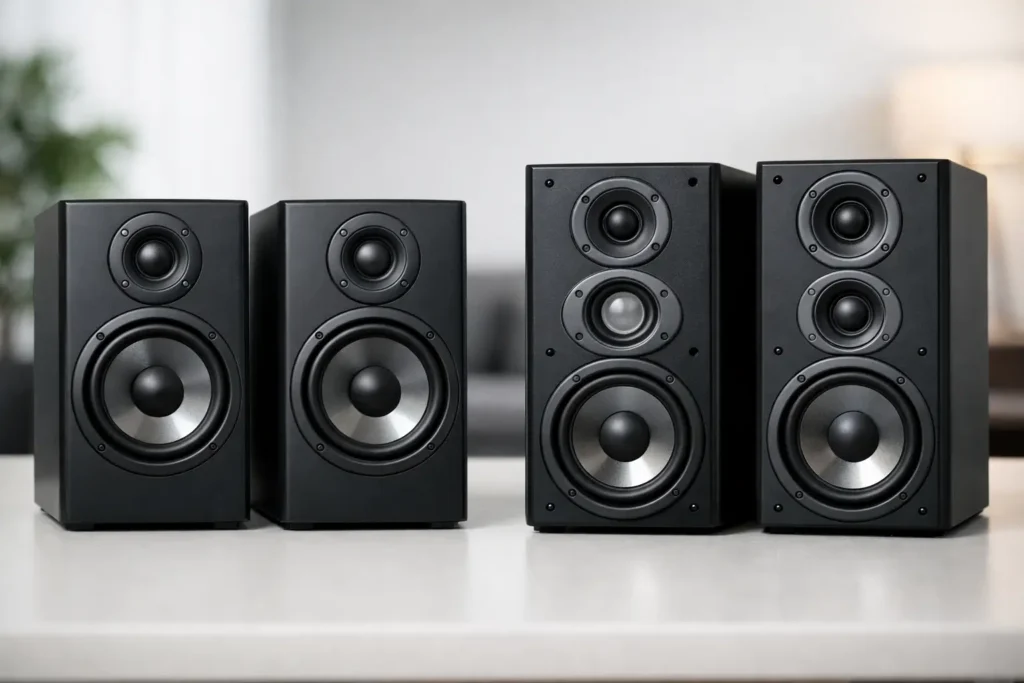
A speaker’s way count refers to the number of frequency bands assigned to separate drivers. A two-way design typically uses a woofer or mid-woofer for bass and much of the midrange, plus a tweeter for high frequencies. A crossover network directs the appropriate portion of the signal to each driver.
A three-way design divides that work further. A woofer handles low frequencies, a dedicated midrange driver reproduces the central musical band, and a tweeter takes over the upper frequencies. The crossover therefore has two transition points rather than one.
This sounds straightforward, but it should not be mistaken for a simple hierarchy. A three-way speaker is not automatically more refined, and a two-way is not inherently more coherent. The success of either approach rests on the quality of the drivers, cabinet, crossover, and the care with which they are integrated.
Two Way vs Three Way Speakers: The Musical Difference
The midrange is where much of music lives. It carries the human voice, the character of a violin, the bite of a saxophone, and the harmonic body of a piano. In a two-way loudspeaker, the mid-woofer must reproduce this critical range while also moving enough air to create bass. That is an ambitious assignment, particularly at higher playback levels.
When executed well, a two-way speaker can offer exceptional immediacy. With fewer drivers and a simpler crossover, there are fewer handoffs to manage. This can contribute to a focused image, an intimate presentation, and a sense that instruments emerge from a single, continuous acoustic source. In the right room, a fine two-way can make a vocal recording feel remarkably direct and present.
A three-way speaker gives the midrange its own dedicated driver. Freed from the deepest bass demands, that driver can often operate in a narrower, more comfortable range. The potential rewards are greater ease during dense orchestral passages, more lifelike scale, and cleaner separation when music becomes complex. A properly designed three-way can preserve the texture of a singer’s breath while a bass line and drum kit maintain convincing authority beneath it.
The operative phrase is properly designed. The presence of a separate midrange driver creates opportunity, not a guarantee.
Why the Crossover Matters More Than the Driver Count
A crossover is not merely a traffic controller. Its slopes, component quality, phase behavior, and interaction with the drivers shape the speaker’s tonal character, imaging, and timing. It is one of the places where engineering becomes audible art.
A two-way crossover must make a graceful transition between drivers that may have very different physical behavior. The woofer becomes more directional as frequencies rise, while the tweeter must be protected from frequencies too low for it to reproduce comfortably. If that handoff is poorly judged, voices can lose their natural body or the upper midrange can become conspicuous.
A three-way system introduces another crossover point, which gives the designer more control but also more responsibility. Each transition must be acoustically seamless. If the woofer, midrange, and tweeter do not behave as a unified whole, the listener may hear the system as separate parts rather than one musical event.
This is why a beautifully voiced two-way can be more persuasive than an indifferent three-way, while an exceptional three-way can reproduce scale and composure that a compact two-way may struggle to match. Specification shorthand cannot replace listening.
Bass, Scale, and Effortlessness
The most practical advantage of many three-way speakers is their ability to move more air without asking the midrange driver to do everything. A larger woofer, or multiple woofers, can be optimized for low-frequency output and control. This can provide deeper bass extension, greater dynamic headroom, and a more relaxed presentation at realistic listening levels.
That ease matters beyond electronic music or large-scale cinema. The lower registers of a grand piano establish the instrument’s physical presence. The resonant body of a cello, the foundation of an upright bass, and the pressure of a concert hall’s timpani all depend on bass that is controlled rather than exaggerated.
A two-way speaker can still deliver satisfying, articulate bass, especially in a modest room or when partnered with carefully chosen subwoofers. Its limitations tend to emerge when the room is large, the listener sits farther away, or the musical program demands both deep bass and substantial dynamic range. At that point, a thoughtfully engineered three-way often sounds less strained, not simply louder.
The Case for the Exceptional Two-Way
There is a particular elegance to a well-conceived two-way loudspeaker. Its smaller cabinet can integrate more easily into refined living spaces, and its simpler driver arrangement may create extraordinarily precise stereo imaging. For listeners who value chamber music, jazz ensembles, vocal recordings, and moderate listening levels, this can be a deeply satisfying path.
Placement also tends to be more forgiving in some rooms. A stand-mounted or slender two-way can be positioned away from walls with relative freedom, allowing the soundstage to open and the speaker to disappear visually and acoustically.
Yet compact dimensions are not the whole story. Cabinet rigidity, internal damping, driver excursion, and bass alignment determine whether a two-way sounds light and agile or merely lightweight. A luxury loudspeaker should not confuse less cabinet volume with less ambition.
Room Size Should Influence the Decision
The room is part of the loudspeaker system. A three-way with serious low-frequency reach can energize a large listening space beautifully, but it may overwhelm a smaller room if placement and bass control are neglected. Deep bass interacts with walls, corners, and furnishings, producing peaks and cancellations that can obscure detail.
For a smaller dedicated listening room, a sophisticated two-way may be the more natural choice. It can deliver scale beyond its physical dimensions without overloading the space. In an open-plan residence, a large room, or a room where the listener sits well back from the speakers, a three-way’s dynamic authority and bass capacity can be more appropriate.
The question is not which format is best in isolation. It is which speaker can develop a convincing relationship with your room. Fine loudspeakers deserve enough space around them to breathe, and the room deserves consideration before any final decision is made.
Matching the Speaker to the Rest of the System
Amplification matters in both designs. A two-way with a demanding impedance curve may require a substantial amplifier despite its modest appearance. A large three-way may be relatively easy to drive but will reveal the character, control, and current capability of the electronics behind it.
The goal is not to assemble the most complicated system. It is to create a system whose components share a sense of balance. Source quality, amplification, cables, speaker placement, and room acoustics all influence whether the loudspeaker can resolve the recording’s emotional and spatial information.
At Gershman Acoustics, that perspective begins with the belief that a loudspeaker should serve the musical performance rather than call attention to its individual parts. The cabinet, drivers, and crossover must act together so that the listener hears the recording’s intention: the space around a jazz trio, the force of an orchestra, or the fragile intimacy of a solitary voice.
How to Listen Before You Choose
An audition should move beyond the first impressive moment. Bring recordings you know intimately and listen for continuity from bass through treble. A voice should not become thin as it rises, and a piano should not sound as if its lower and upper registers belong to different instruments.
Pay attention to what happens as volume increases. Does the soundstage remain organized? Does the bass stay textured? Does the speaker retain tonal calm when a recording becomes dense? A superior design often feels less like an audio effect and more like an unforced opening into the recorded event.
Also listen quietly. Many speakers can impress with volume, but the finest designs preserve tonal color, dimensionality, and emotional connection at low levels. That quality becomes especially meaningful during late-night listening, when music should remain complete rather than reduced to a faint outline.
The most rewarding choice will be the speaker that makes you forget the question of ways altogether. When a familiar recording reveals a phrase, a pause, or an instrumental color you had not fully felt before, the system has done what it was meant to do: bring you closer to the music.